
Call (905)-800-1661
A concussion does not show up on an X-ray, does not always involve losing consciousness, and often does not seem serious at the time. But the headaches, dizziness, fog, and fatigue that follow can drag on for weeks — and for some people, months. If you or your child hit your head in a hockey game, a car accident, a fall, or a workplace incident and are still not feeling normal, physiotherapy can help.
Modern concussion care has moved well beyond “rest in a dark room until it passes.” At Rishaan Physio & Wellness Clinic in Mississauga, our physiotherapists use an active, evidence-based approach that treats the specific systems affected by the injury — the neck, the balance system, the visual system, and exercise tolerance — and guides a safe return to school, work, and sport.
What Is a Concussion?
A concussion is a mild traumatic brain injury caused by a blow to the head or a force that makes the head move rapidly — such as whiplash in a collision. The impact disrupts normal brain function temporarily. Most concussions do not cause structural damage visible on imaging, but they produce a wide range of physical, cognitive, and emotional symptoms.
Common causes we see in Mississauga include hockey, soccer, and football injuries, motor vehicle accidents, falls (especially in seniors and young children), workplace incidents, and cycling accidents.
Concussion Symptoms
Symptoms may appear immediately or develop over the following hours and days:
- Physical — headache, dizziness, nausea, balance problems, sensitivity to light and noise, blurred vision, fatigue, neck pain
- Cognitive — brain fog, difficulty concentrating, slowed thinking, memory problems, feeling “not right”
- Emotional — irritability, anxiety, low mood, feeling overwhelmed
- Sleep — sleeping more or less than usual, trouble falling asleep
Seek emergency care immediately if there is worsening headache, repeated vomiting, seizures, weakness or numbness, slurred speech, increasing confusion or drowsiness, or unequal pupils.
Why Symptoms Linger: It’s Rarely Just the Brain
Most concussions resolve within two to four weeks. When symptoms persist beyond that — often called post-concussion syndrome — the cause is usually not ongoing brain injury but dysfunction in one or more related systems that were injured at the same time:
- The neck — the same force that concusses the brain strains the neck. Neck joints and muscles can generate headaches, dizziness, and fog that mimic concussion symptoms
- The vestibular (balance) system — the inner ear and its brain connections can be disturbed, causing dizziness, imbalance, and motion sensitivity
- The visual system — eye tracking and focusing can be affected, causing headaches with screens and reading, and difficulty in busy visual environments
- Exercise intolerance — disrupted regulation of blood flow to the brain causes symptoms to spike with exertion
- Deconditioning and anxiety — prolonged rest and worry about symptoms can themselves prolong recovery
Each of these responds to specific treatment — which is why a thorough assessment is the first step.
Call (905)-800-1661
How Physiotherapy Treats Concussion
1. Comprehensive assessment
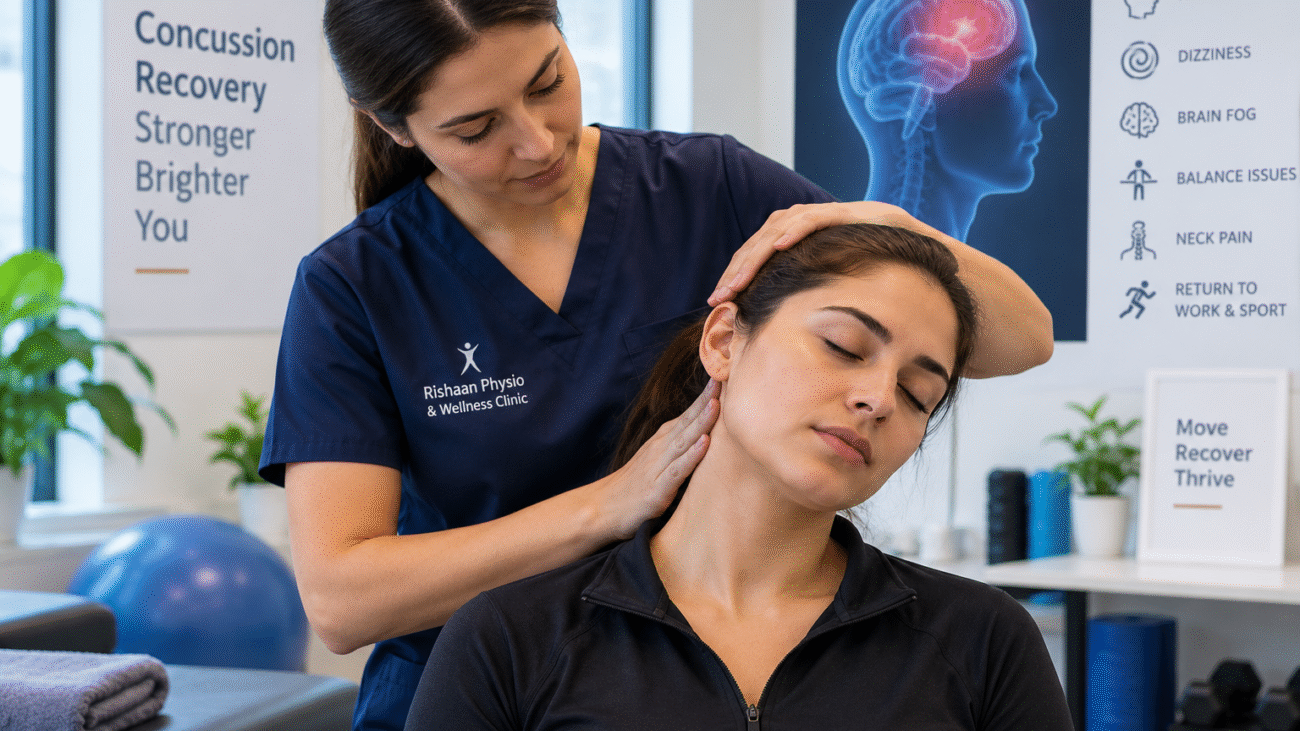
We take a detailed history of the injury and your symptoms, then examine the neck, balance and vestibular function, eye movements, and your tolerance to controlled exercise. This tells us which systems are involved and where to focus.
2. Neck (cervical) treatment
Manual therapy, mobilization, and gentle strengthening for the neck joints and muscles. For many patients — especially after whiplash-type injuries — treating the neck produces rapid improvement in headaches and dizziness. Read more about whiplash treatment.
3. Vestibular rehabilitation
Specific exercises that retrain the balance system, reduce dizziness and motion sensitivity, and improve stability. Learn more about our vestibular physiotherapy program.
4. Visual and oculomotor training
Exercises to restore smooth eye tracking, focusing, and coordination between the eyes and the balance system — reducing screen-related headaches and improving reading tolerance.
5. Graded exercise therapy
Controlled, sub-symptom-threshold aerobic exercise — typically on a stationary bike or treadmill — has been shown to speed recovery. We establish your safe intensity and progress it gradually as tolerance improves.
6. Education and pacing
Guidance on managing screens, sleep, activity, and cognitive load so you stay active without overdoing it. Complete rest beyond the first 24–48 hours is no longer recommended.
7. Return-to-learn, return-to-work, and return-to-play
Step-by-step protocols to reintroduce school, work, and sport safely, with clear criteria before each progression. For athletes, we follow current international consensus guidelines — no return to contact sport until fully symptom-free and cleared.
Concussion in Children and Teens
Young people take longer to recover from concussion on average and are more vulnerable to a second injury during recovery. Ontario’s Rowan’s Law requires sport organizations to follow concussion protocols, and schools have return-to-learn procedures. Our physiotherapists work with parents, coaches, and teachers to guide a gradual return to the classroom before the return to sport. For hockey families, see our guide to hockey season injuries.
Concussion After a Car Accident
Concussions are frequently missed after motor vehicle accidents because attention goes to the obvious neck and back pain. If you have headaches, fog, or dizziness after a collision, tell your physiotherapist. Concussion treatment is covered under Ontario’s auto insurance accident benefits, and we bill your insurer directly — see our guide to MVA physiotherapy and claims.
Supporting Treatments
- Registered massage therapy — for the neck and shoulder tension that often accompanies and aggravates post-concussion headaches
- Acupuncture — for headache, sleep disturbance, and anxiety during recovery
- Chiropractic care — gentle treatment for restricted upper neck joints contributing to headaches and dizziness
Why Choose Rishaan Physio for Concussion Care in Mississauga
- Physiotherapists trained in current, evidence-based concussion management
- Neck, vestibular, visual, and exercise-based treatment in one clinic
- Structured return-to-learn, work, and sport protocols
- Direct billing to extended health plans, MVA insurance, and WSIB
- Open 7 days a week, same-day appointments
- Free pickup and drop-off — important when dizziness or light sensitivity makes driving unsafe
- Unit 7, 5105 Hurontario Street, Mississauga — Hurontario & Eglinton
Frequently Asked Questions
How long does a concussion take to heal?
Most adults recover within 2–4 weeks and most children within 4 weeks. Symptoms lasting longer usually indicate a treatable issue in the neck, balance, or visual system rather than ongoing brain injury.
Should I rest completely after a concussion?
Only for the first 24–48 hours. After that, gradual return to light activity — including gentle exercise — is recommended and speeds recovery. Prolonged rest can make symptoms worse.
Do I need a doctor’s referral for concussion physiotherapy?
No, though we recommend seeing a physician after any head injury to rule out serious injury. Some insurance plans request a referral for reimbursement.
Is concussion treatment covered by insurance?
Yes — by extended health plans for physiotherapy, and fully by auto insurance or WSIB if the injury happened in a car accident or at work. We bill directly.
Clear the Fog — Start Your Concussion Recovery
Same-day appointments • Direct billing • Open 7 days • Free pickup & drop-off
Call (905)-800-1661Rishaan Physio & Wellness Clinic — Unit 7, 5105 Hurontario St, Mississauga, ON L4Z 0C9