

When most people think of acupuncture, they think of pain relief — neck pain, back pain, sports injuries. But acupuncture’s effects extend well beyond the musculoskeletal system. An increasingly robust body of research supports acupuncture as an effective complementary therapy for anxiety, chronic stress, and stress-related physical symptoms.
At Rishaan Physio & Wellness Clinic in Mississauga, we regularly treat patients whose physical symptoms — tension headaches, muscle tightness, sleep disruption, digestive issues, and chronic pain — are driven or worsened by anxiety and stress. Acupuncture addresses both the physical and neurological dimensions of these conditions.
Here’s what the science says, and what you can realistically expect from acupuncture for anxiety in Mississauga.
HOW ACUPUNCTURE WORKS FOR ANXIETY
Traditional Chinese Medicine explains acupuncture through the concept of qi (life energy) flowing through channels called meridians. While this framework has cultural and historical value, modern neuroscience offers a complementary explanation:
NEUROLOGICAL MECHANISMS
Acupuncture needle insertion stimulates sensory nerve fibres (A-delta and C fibres) that carry signals to the brain. This activates the hypothalamus — the brain’s stress regulation centre — and modulates the hypothalamic-pituitary-adrenal (HPA) axis, which governs our stress hormone response.
Specifically, acupuncture has been shown to:
- Reduce cortisol levels (the primary stress hormone)
- Increase serotonin and endorphin release
- Activate the parasympathetic nervous system (the “rest and digest” state, counteracting the “fight or flight” response)
- Modulate the amygdala — the brain’s fear and anxiety centre
THE EVIDENCE
A 2018 systematic review and meta-analysis published in Evidence-Based Complementary and Alternative Medicine reviewed 20 randomised controlled trials and found that acupuncture was significantly more effective than control conditions at reducing anxiety symptoms. Effect sizes were particularly strong for Generalised Anxiety Disorder (GAD).
A 2017 study in Acupuncture in Medicine found that ear acupuncture (auricular acupuncture) reduced pre-operative anxiety as effectively as pharmacological sedation — without the side effects.
The World Health Organisation (WHO) lists anxiety disorders as one of the conditions for which acupuncture has demonstrable therapeutic effect.
WHAT CONDITIONS BENEFIT FROM ACUPUNCTURE FOR STRESS?
Acupuncture is most commonly used for anxiety and stress relief in the following situations:
GENERALISED ANXIETY DISORDER (GAD)
Persistent, excessive worry that is difficult to control. Acupuncture is used as a complement to cognitive behavioural therapy (CBT) and, in some cases, as an alternative to medication for patients who prefer non-pharmacological approaches.
STRESS-RELATED INSOMNIA
Anxiety-driven sleep disruption is one of the most responsive conditions to acupuncture. Most patients report improved sleep quality within 3–5 sessions. Acupuncture regulates the release of melatonin and reduces the sympathetic nervous system arousal that keeps people awake at night.
PANIC DISORDER
While panic disorder typically requires psychological treatment and sometimes medication, acupuncture can reduce the frequency and intensity of panic attacks by calming the HPA axis response.
STRESS-RELATED PHYSICAL SYMPTOMS
Many patients come to Rishaan Physio with physical complaints — tight shoulders, tension headaches, jaw clenching (TMJ), digestive discomfort, and fatigue — that are significantly driven by chronic stress. Acupuncture addresses both the psychological and physical dimensions simultaneously.
PERFORMANCE ANXIETY AND SITUATIONAL STRESS
Acupuncture sessions before high-pressure events (exams, presentations, medical procedures) can reduce acute anxiety without cognitive impairment — unlike anxiolytic medications.
WHAT DOES AN ACUPUNCTURE SESSION FOR ANXIETY FEEL LIKE?
Acupuncture for anxiety typically feels deeply relaxing — often the opposite of what first-time patients expect. Here’s what a typical session looks like at Rishaan Physio:
Initial Consultation (First Visit)
Your acupuncturist takes a detailed health history, including your anxiety symptoms, sleep patterns, stress triggers, and physical complaints. A tongue and pulse assessment may also be conducted as part of traditional diagnostic methods.
Needle Insertion
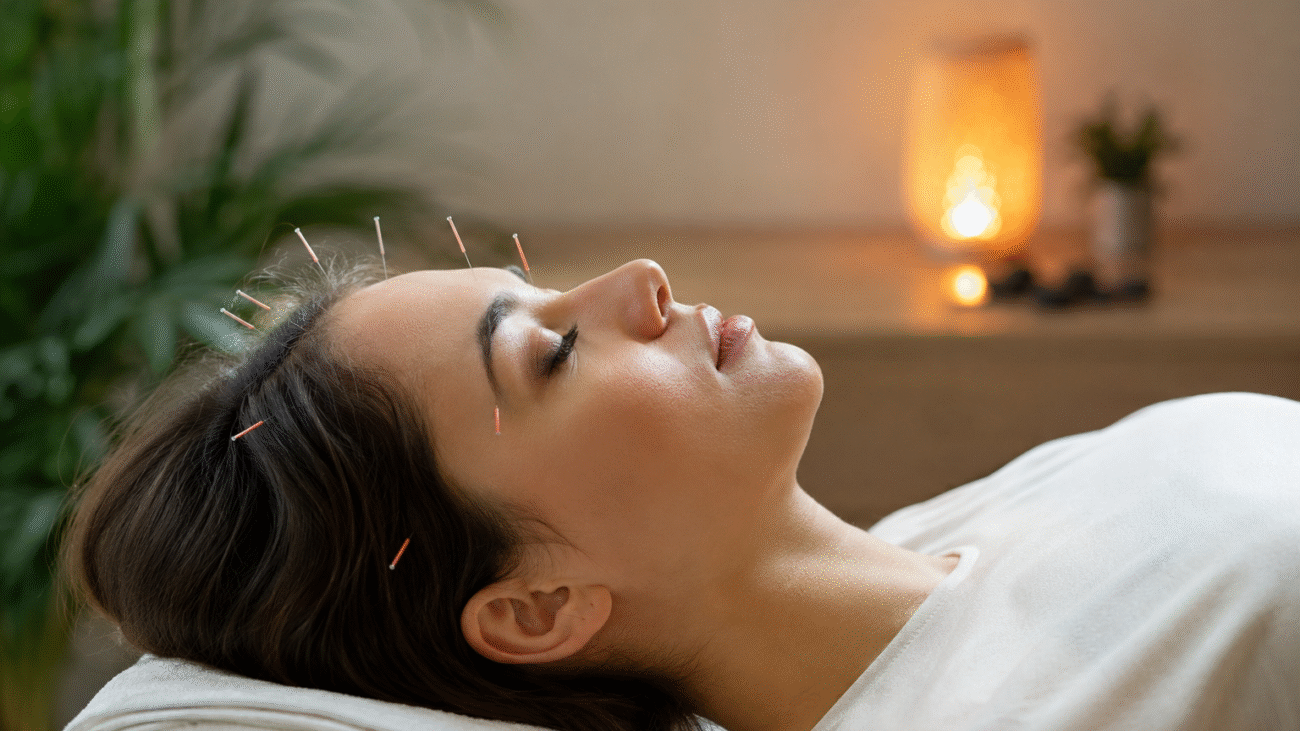
Fine, sterile, single-use needles (thinner than a human hair) are inserted at specific acupuncture points — commonly on the wrists, forearms, lower legs, and scalp for anxiety treatment. Insertion is typically painless or produces a brief, dull ache (called “de qi”) that passes quickly.
Rest Period
Most patients lie comfortably for 20–30 minutes with the needles retained. This is typically described as profoundly relaxing — many patients fall asleep. After the needles are removed, patients commonly feel calm, slightly drowsy, and physically lighter.
HOW MANY SESSIONS WILL I NEED?
Most patients notice meaningful improvements in anxiety and sleep after 4–6 sessions. A typical initial course for anxiety management is 8–10 sessions, after which many patients move to maintenance treatment of once or twice a month.
Unlike medication, acupuncture has no withdrawal effects and does not create dependency. The calming effects also tend to be cumulative — meaning they build and last longer over successive sessions.
IS ACUPUNCTURE SAFE FOR ANXIETY?
Yes — when performed by a trained practitioner using sterile, single-use needles, acupuncture is extremely safe. At Rishaan Physio in Mississauga, all acupuncture is performed by registered practitioners trained in both traditional acupuncture and the physiological mechanisms of needle therapy.
Side effects are rare and minor when they occur:
- Mild bruising at needle sites
- Temporary soreness
- Occasional lightheadedness immediately after treatment (resolved by resting briefly)
Acupuncture is safe during pregnancy (with appropriate point selection), for elderly patients, and for those taking most medications. Your practitioner will conduct a thorough contraindication screening before treatment.
ACUPUNCTURE AND YOUR EXISTING MENTAL HEALTH TREATMENT
Acupuncture is best understood as a complementary therapy — not a replacement for psychological treatment or psychiatric medication when these are clinically indicated. If you are seeing a therapist, psychiatrist, or family physician for anxiety, acupuncture can work alongside your existing care to enhance outcomes.
We recommend discussing acupuncture with your mental health care team, especially if you are taking anti-anxiety medications, as acupuncture can affect how the body responds to medication.
FREQUENTLY ASKED QUESTIONS
Q: Can acupuncture cure anxiety?
A: Acupuncture is not a cure for anxiety disorders. However, it is an effective tool for managing symptoms, reducing the frequency and intensity of anxiety episodes, and improving sleep, mood, and physical wellbeing. Many patients report that regular acupuncture significantly reduces their need for anxiolytic medication over time — though any medication changes should be made in consultation with your physician.
Q: How quickly will I feel calmer after acupuncture?
A: Many patients report feeling noticeably calmer immediately after their first session. Lasting improvements in baseline anxiety typically develop over 3–6 sessions.
Q: Is acupuncture covered by insurance in Ontario?
A: Many extended health insurance plans in Ontario cover acupuncture services. Check your plan for annual maximums and per-visit limits. We offer direct billing at Rishaan Physio for most major insurers.
Q: Can I have acupuncture if I’m afraid of needles?
A: Many needle-phobic patients are surprised to find that acupuncture needles feel nothing like injection needles — they are extremely fine and inserted superficially. We take time with nervous patients and can start with minimal needles to build comfort. Ear acupressure (using seeds instead of needles) is also an option.
Q: What acupuncture points are used for anxiety?
A: Common points used for anxiety include Heart 7 (HT7) on the wrist, Pericardium 6 (PC6) on the forearm, Governor Vessel 24.5 (Yintang) between the eyebrows, Kidney 1 (KI1) on the sole of the foot, and various ear points. The specific selection is individualised to each patient.
BOOK AN ACUPUNCTURE APPOINTMENT IN MISSISSAUGA
If stress and anxiety are affecting your health, sleep, or quality of life, acupuncture at Rishaan Physio may offer the relief you’re looking for — without medication side effects or lengthy waitlists.
Rishaan Physio & Wellness Clinic
5105 Hurontario St, Unit 7, Mississauga, ON
Phone: (905) 800-1661
Website: rishaanphysio.com
Open 7 days a week | Free pickup & drop-off