

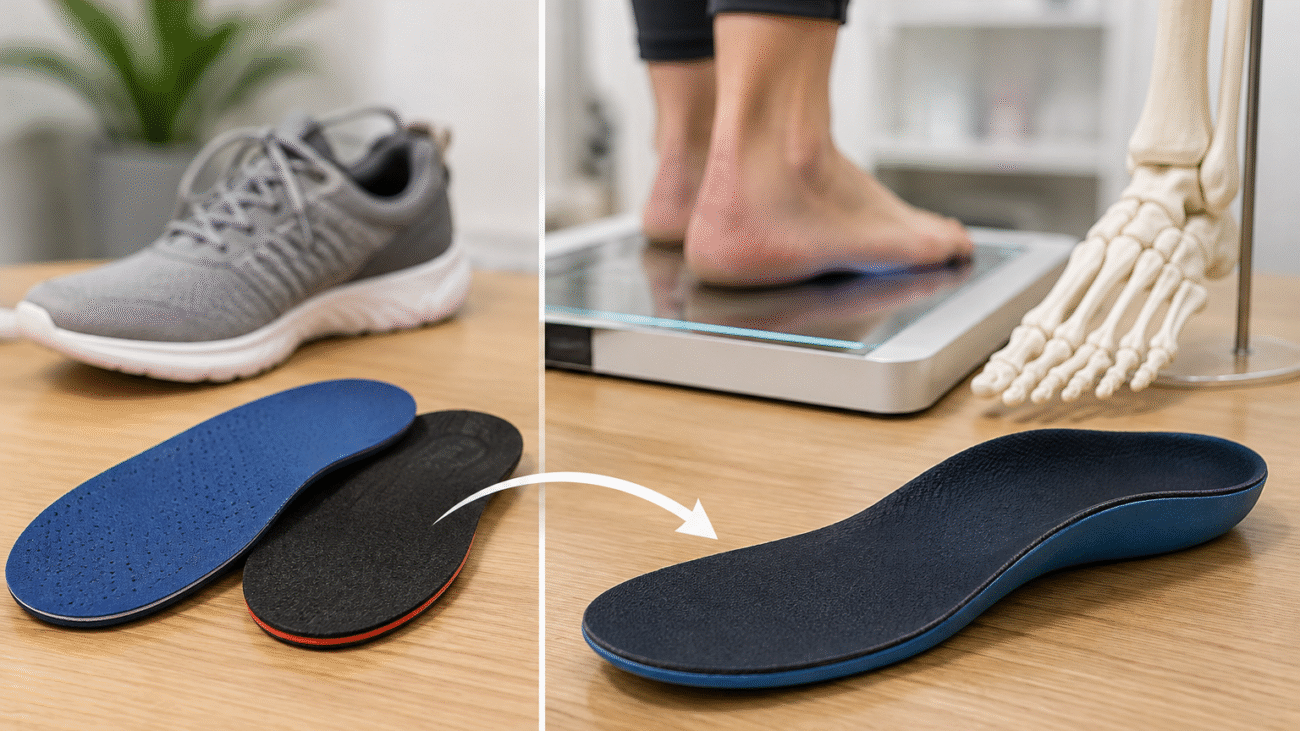
You’re standing in a pharmacy, looking at a rack of insoles ranging from $15 to $85. They promise arch support, cushioning, and relief from foot pain. Meanwhile, your physiotherapist has recommended custom orthotics — and the price difference is significant.
So what’s the real difference between custom orthotics and store-bought insoles? And how do you know which one you actually need?
At Rishaan Physio & Wellness Clinic in Mississauga, we prescribe custom orthotics as part of our treatment plans for a wide range of conditions — from plantar fasciitis to knee pain to lower back dysfunction. Here’s an honest, evidence-based comparison.
WHAT ARE STORE-BOUGHT INSOLES?
Over-the-counter (OTC) insoles are prefabricated, mass-produced foot supports designed for general foot shapes. They come in different sizes and sometimes different arch height categories (low, medium, high), and they are made from foam, gel, or a combination of materials.
What they can do:
- Provide cushioning and shock absorption
- Offer mild arch support
- Reduce general foot fatigue from prolonged standing
- Provide temporary comfort relief for mild foot discomfort
What they cannot do:
- Address biomechanical issues specific to your foot structure
- Correct overpronation, supination, or leg length discrepancies precisely
- Adequately control rearfoot motion for complex conditions
- Provide the structural rigidity needed for serious pathologies
WHAT ARE CUSTOM ORTHOTICS?
Custom orthotics are medical devices prescribed and fabricated specifically for your feet and your gait pattern. At Rishaan Physio in Mississauga, the custom orthotic process involves:
1. Comprehensive biomechanical assessment
Your physiotherapist assesses your foot structure, arch height, rearfoot alignment, ankle mobility, knee alignment, hip mechanics, and walking pattern (gait analysis). This gives us a complete picture of how your entire lower limb functions — not just your foot in isolation.
2. Foot casting or 3D scanning
A precise cast or 3D digital scan is taken of your feet in the subtalar neutral position — the functional position in which the foot is biomechanically most efficient. This captures the exact geometry of your foot.
3. Laboratory fabrication
The orthotic is fabricated by a certified orthotics laboratory from materials selected based on your weight, activity level, and condition. The device is designed to achieve specific biomechanical corrections unique to your assessment findings.
4. Fitting and follow-up
When your orthotics arrive, your physiotherapist ensures they fit correctly and makes any necessary adjustments. A follow-up assessment confirms the expected biomechanical improvements.
KEY DIFFERENCES: A SIDE-BY-SIDE COMPARISON
CUSTOMISATION
Store-bought: Generic shape for average foot geometry
Custom: Fabricated to your precise foot shape and biomechanics
BIOMECHANICAL CORRECTION
Store-bought: Minimal — cushioning only
Custom: Addresses specific pathologies — overpronation, supination, plantar fasciitis, etc.
MATERIAL AND DURABILITY
Store-bought: Foam or gel — typically lasts 6–12 months before compression
Custom: Rigid or semi-rigid shell with cushioning top cover — typically lasts 3–5 years
PRESCRIPTION-BASED
Store-bought: No professional assessment required
Custom: Prescribed by a regulated health professional following clinical assessment
INSURANCE COVERAGE
Store-bought: Not covered
Custom: Covered by most extended health plans in Ontario (typically $200–$500 per year)
COST
Store-bought: $15–$90
Custom: $400–$600 (largely offset by insurance for most patients with benefits)
WHEN STORE-BOUGHT INSOLES ARE SUFFICIENT
Store-bought insoles can be genuinely helpful in specific situations:
- You have mild foot fatigue from prolonged standing (retail work, hospitality)
- You need temporary cushioning for a specific pair of shoes
- You’re using them as a short-term comfort measure while awaiting a professional assessment
- You have no biomechanical abnormalities and simply want additional cushioning
WHEN YOU NEED CUSTOM ORTHOTICS
Custom orthotics are clinically indicated when:
PLANTAR FASCIITIS
The plantar fascia — the band of tissue on the bottom of your foot — is stressed by abnormal foot mechanics. Custom orthotics that control rearfoot pronation and off-load the plantar fascia are one of the most effective conservative treatments for chronic plantar fasciitis. Multiple clinical trials show custom orthotics superior to OTC insoles for this condition.
PATELLOFEMORAL PAIN SYNDROME (RUNNER’S KNEE)
Overpronation of the foot causes internal rotation of the tibia and femur, increasing compressive forces on the kneecap. Custom orthotics correct this mechanical chain and significantly reduce anterior knee pain.
ACHILLES TENDINOPATHY
A heel lift integrated into custom orthotics reduces tensile load on the Achilles tendon during the acute phase of treatment.
LOWER BACK PAIN FROM LEG LENGTH DISCREPANCY
A structural leg length difference of as little as 6mm can cause significant pelvic tilt and lumbar compensations. Custom orthotics with a heel lift on the shorter side correct this discrepancy and reduce lumbar loading.
DIABETIC FOOT CONDITIONS
Diabetic patients require custom orthotics to redistribute pressure across the foot, reducing the risk of ulceration and skin breakdown.
OVERPRONATION OR SUPINATION
Significant rearfoot valgus (pronation) or varus (supination) requires a structured custom device to control joint motion — not just cushioning.
HOW TO KNOW WHICH ONE YOU NEED
The honest answer is: get assessed. A comprehensive biomechanical assessment at Rishaan Physio in Mississauga takes approximately 45 minutes and gives you a clear clinical picture of your foot mechanics and whether custom orthotics are genuinely indicated for your condition.
We will never recommend custom orthotics unless your assessment findings support their use. If a store-bought insole will serve your needs, we’ll tell you that too.
INSURANCE COVERAGE FOR CUSTOM ORTHOTICS IN ONTARIO
Most extended health insurance plans in Ontario cover custom orthotics, provided they are:
- Prescribed by a registered healthcare provider (physiotherapist, chiropodist, or physician)
- Accompanied by a biomechanical assessment on file
- Fabricated by an accredited laboratory
At Rishaan Physio, we provide all required documentation for insurance claims and offer direct billing where available. Our team will help you maximise your annual orthotic benefit.
FREQUENTLY ASKED QUESTIONS
Q: How long do custom orthotics last?
A: With proper care, custom orthotics typically last 3–5 years. The top cover cushioning may need replacing after 1–2 years. Children’s orthotics typically need replacement more frequently as their feet grow.
Q: Do I need a prescription for custom orthotics?
A: In Ontario, custom orthotics must be prescribed by a regulated health professional (physiotherapist, chiropodist, or physician) to qualify for insurance reimbursement. An assessment is required regardless.
Q: Will I feel immediate improvement with custom orthotics?
A: It typically takes 2–4 weeks to fully break in custom orthotics and notice the full therapeutic benefit. Some patients feel immediate improvement; others go through an adjustment period. Your physiotherapist will guide you through the break-in protocol.
Q: Can I use custom orthotics in multiple pairs of shoes?
A: Yes — most custom orthotics are designed to be transferred between shoes of similar types (e.g., running shoes, dress shoes). We can discuss footwear compatibility at your assessment.
BOOK YOUR ORTHOTIC ASSESSMENT IN MISSISSAUGA
Rishaan Physio & Wellness Clinic
5105 Hurontario St, Unit 7, Mississauga, ON
Phone: (905) 800-1661
Website: rishaanphysio.com
Open 7 days a week | Direct billing available