

Call (905)-800-1661
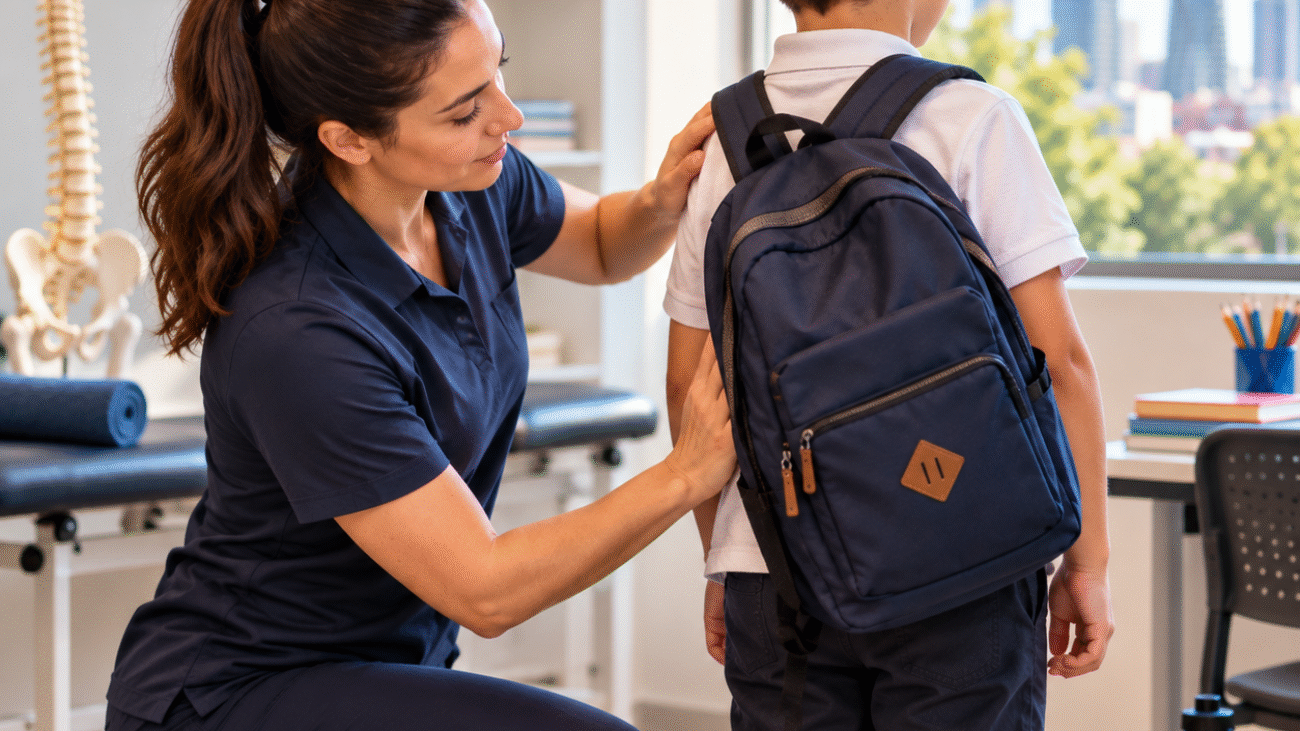
September in Mississauga means new school shoes, packed lunches, and backpacks that seem to get heavier every year. Between textbooks, a laptop, a water bottle, gym clothes, and whatever else ends up at the bottom of the bag, many children are carrying far more weight than their developing spines are built to handle.
Every fall, our physiotherapists and chiropractor at Rishaan Physio & Wellness Clinic see a noticeable rise in children and teenagers coming in with back pain, neck stiffness, and shoulder discomfort — and in a large number of cases, the backpack is a major contributor. This guide explains what parents should watch for, how much weight is actually safe, and what to do if the pain has already started.
How Much Should a Child’s Backpack Weigh?
The guideline most physiotherapists and paediatric health organizations follow is simple: a backpack should weigh no more than 10–15% of the child’s body weight. For a 30 kg (66 lb) child in grade 3, that means a maximum of 3–4.5 kg (7–10 lb). For a 50 kg (110 lb) teenager, the limit is around 5–7.5 kg (11–16 lb).
When we ask parents to actually weigh their child’s loaded bag at home, the result is often surprising. Bags weighing 20–25% of body weight are common, especially among middle and high school students who carry every subject’s materials to avoid locker trips.
Why Heavy Backpacks Cause Pain in Children
A child’s spine is still growing. The vertebrae, discs, and supporting muscles are not fully developed until the late teens, which makes them more vulnerable to sustained load than an adult’s. A heavy or poorly worn backpack creates several problems:
- Forward lean — to counterbalance the weight behind them, children lean forward from the hips or round their upper back, straining the lower back and neck muscles
- Uneven loading — carrying the bag on one shoulder shifts the spine sideways and overworks one side of the body
- Shoulder and nerve compression — narrow or tight straps dig into the shoulders, sometimes causing tingling or numbness in the arms
- Muscle fatigue — the muscles of the neck, upper back, and core tire quickly, which leads to slouching and further strain
- Altered walking pattern — heavy loads change stride and balance, increasing the chance of trips and falls
Over a full school year, five days a week, these small stresses add up. The result is often a child who “always has a sore back” without any single injury to explain it.
Warning Signs Parents Should Not Ignore
Children do not always describe pain clearly, so it helps to watch for behaviour as well as complaints. Signs that a backpack may be causing a problem include:
- Complaints of back, neck, or shoulder pain, especially at the end of the school day
- Red marks or indentations on the shoulders after removing the bag
- Struggling to lift the bag or needing help putting it on
- Leaning noticeably forward or to one side while walking with the bag
- Tingling, numbness, or weakness in the arms or hands
- Reluctance to walk to school or carry the bag at all
- Persistent poor posture even when the bag is off
Pain that lasts more than a week or two, or that wakes a child at night, should always be assessed by a health professional rather than waited out.
Call (905)-800-1661
How to Choose and Pack a Backpack Correctly
Most backpack-related pain can be prevented with a few practical changes. Here is what our team recommends to Mississauga parents:
Choosing the right bag
- Two wide, padded shoulder straps — never a single-strap or messenger-style bag for daily school use
- A padded back panel that sits flat against the spine
- A waist or chest strap to transfer some of the weight to the hips and keep the bag stable
- Correct size — the bag should not extend above the shoulders or more than 10 cm below the waistline
- Multiple compartments so weight can be distributed rather than piled in one section
Packing and wearing it properly
- Place the heaviest items (textbooks, laptop) closest to the back
- Tighten the straps so the bag sits snugly against the mid-back, not swinging low near the hips
- Always use both shoulder straps
- Do a weekly “bag audit” — remove anything that does not need to travel daily
- Encourage locker use and, where possible, digital textbooks or a second set of books at home
Simple Exercises to Strengthen Your Child’s Back
A stronger core and upper back make a child far more resilient to carrying load. These are safe for most school-aged children and take under five minutes:
- Superman holds — lying face down, lift arms and legs slightly off the floor and hold for 5 seconds. Repeat 8–10 times.
- Wall angels — standing with back and arms against a wall, slowly slide the arms up and down like a snow angel. 10 repetitions.
- Bird-dog — on hands and knees, extend the opposite arm and leg, hold 3 seconds, switch sides. 8 each side.
- Shoulder blade squeezes — squeeze the shoulder blades together and hold for 5 seconds. Repeat 10 times, great for after homework.
If your child already has pain, have them assessed before starting any exercise program so the plan matches their specific needs.
When to See a Physiotherapist or Chiropractor
Book an assessment if your child’s pain has lasted more than one to two weeks, keeps returning, limits their activity or sport, or comes with numbness, tingling, or visible postural changes such as one shoulder sitting higher than the other. These signs sometimes point to issues beyond the backpack — such as early scoliosis, muscle imbalances from sport, or growth-related conditions — which are far easier to manage when caught early.
How We Treat Backpack-Related Pain at Rishaan Physio
Children and teenagers are treated differently from adults. Our approach at the clinic is gentle, age-appropriate, and focused on education as much as hands-on care:
- Full postural and spinal assessment to rule out underlying conditions and identify exactly where the strain is coming from
- Physiotherapy — manual therapy to relieve tight muscles, plus a short, realistic home exercise program for strength and posture
- Chiropractic care — gentle, paediatric-appropriate adjustments for spinal alignment where indicated
- Registered massage therapy for older teens with significant muscle tension
- Parent and child education — we go through the backpack itself, how it is being worn, and daily habits like screen time and study posture (see our guide on posture correction)
Most children improve significantly within a few sessions once the load is corrected and the supporting muscles are strengthened.
Why Mississauga Families Choose Rishaan Physio
- Registered physiotherapists and chiropractor experienced with children and teens
- Same-day appointments — including evenings and weekends that fit around school
- Direct billing to extended health plans — most families pay nothing upfront
- Open 7 days a week
- Free pickup and drop-off service
- Located at Unit 7, 5105 Hurontario Street (Hurontario & Eglinton) — minutes from schools across Heartland, Cooksville, and central Mississauga
Frequently Asked Questions
Can a heavy backpack cause permanent damage to a child’s spine?
In most cases, no — the pain is muscular and resolves once the load is corrected. However, prolonged heavy carrying can worsen existing postural problems or conditions like scoliosis, which is why persistent pain should be assessed.
Are rolling backpacks a better option?
They remove the load from the spine, but many schools restrict them and stairs make them awkward. For most children, a properly fitted two-strap backpack at a safe weight is the more practical solution.
Does my child need a doctor’s referral for physiotherapy or chiropractic care in Ontario?
No referral is needed. You can book directly with us. Some insurance plans request a referral for reimbursement, so check your policy or ask our front desk.
Is physiotherapy for children covered by insurance?
Most extended health plans cover dependants for physiotherapy, chiropractic, and massage therapy. We bill your insurer directly.
Give Your Child a Pain-Free School Year
Same-day appointments • Direct billing • Open 7 days • Free pickup & drop-off
Call (905)-800-1661Rishaan Physio & Wellness Clinic — Unit 7, 5105 Hurontario St, Mississauga, ON L4Z 0C9