
Mississauga is one of Ontario’s largest business hubs — home to thousands of office workers, remote professionals, financial services employees, and tech workers who spend 6, 8, or even 10 hours a day seated at a desk. And this prolonged sitting is silently causing an epidemic of neck pain, headaches, upper back tightness, lower back pain, and shoulder dysfunction.
The most common advice? “Sit up straight.” But posture correction is far more complex — and far more achievable — than a simple reminder to straighten your spine. At Rishaan Physio & Wellness Clinic in Mississauga, our physiotherapists have helped hundreds of desk workers not just manage posture-related pain, but genuinely correct the underlying muscle imbalances that cause it.
WHY DESK WORK DESTROYS YOUR POSTURE
The human body was not designed for prolonged sitting. When you sit — particularly in the typical office posture — a cascade of muscular and skeletal adaptations occur:
FORWARD HEAD POSTURE (TECH NECK)
For every inch your head moves forward of its neutral position over the spine, the effective weight on your cervical spine increases dramatically. Most desk workers carry their head 2–3 inches forward — effectively loading their cervical spine with 27–42 pounds (compared to the normal 12 pounds in neutral). Over years, this causes:
- Deep cervical flexor muscle inhibition and weakness
- Upper trapezius and levator scapulae tightening and pain
- Cervicogenic headaches
- Disc compression at C5-C6 and C6-C7
ROUNDED SHOULDERS (PROTRACTED SCAPULAE)
Hours of typing and mouse use cause the pectoral muscles (chest) to shorten and tighten, while the middle and lower trapezius and rhomboids (upper back muscles) become lengthened and weak. This imbalance pulls the shoulders forward, narrows the subacromial space (contributing to shoulder impingement), and creates chronic upper back pain.
KYPHOTIC THORACIC SPINE
The mid-back (thoracic spine) becomes excessively rounded — a posture called hyperkyphosis. This restricts breathing depth, increases lower back compensatory strain, and limits overhead mobility.
ANTERIOR PELVIC TILT AND TIGHT HIP FLEXORS
Prolonged sitting tightens the hip flexors (psoas and iliacus) and inhibits the gluteal muscles. The resulting anterior pelvic tilt increases lumbar lordosis and places chronic compressive load on the lumbar discs and facet joints — the anatomical basis for the epidemic of lower back pain among office workers.
COMMON SYMPTOMS OF DESK-WORK POSTURE PROBLEMS
- Persistent neck pain and stiffness
- Tension headaches (daily or recurring)
- Upper back aching between the shoulder blades
- Shoulder tightness and restricted mobility
- Lower back pain that worsens through the day
- Hip tightness and difficulty standing fully upright
- Jaw clenching and TMJ discomfort
- Eye strain and fatigue (related to screen positioning)
- Tingling or numbness in the hands (from cervical nerve compression)
HOW PHYSIOTHERAPY CORRECTS POSTURE
Posture correction is not about willpower or reminding yourself to sit up. It’s about systematically addressing the muscle imbalances and movement patterns that your body has developed over years of desk work. This requires professional guidance — and a structured program.
At Rishaan Physio in Mississauga, posture correction involves:
POSTURAL ASSESSMENT
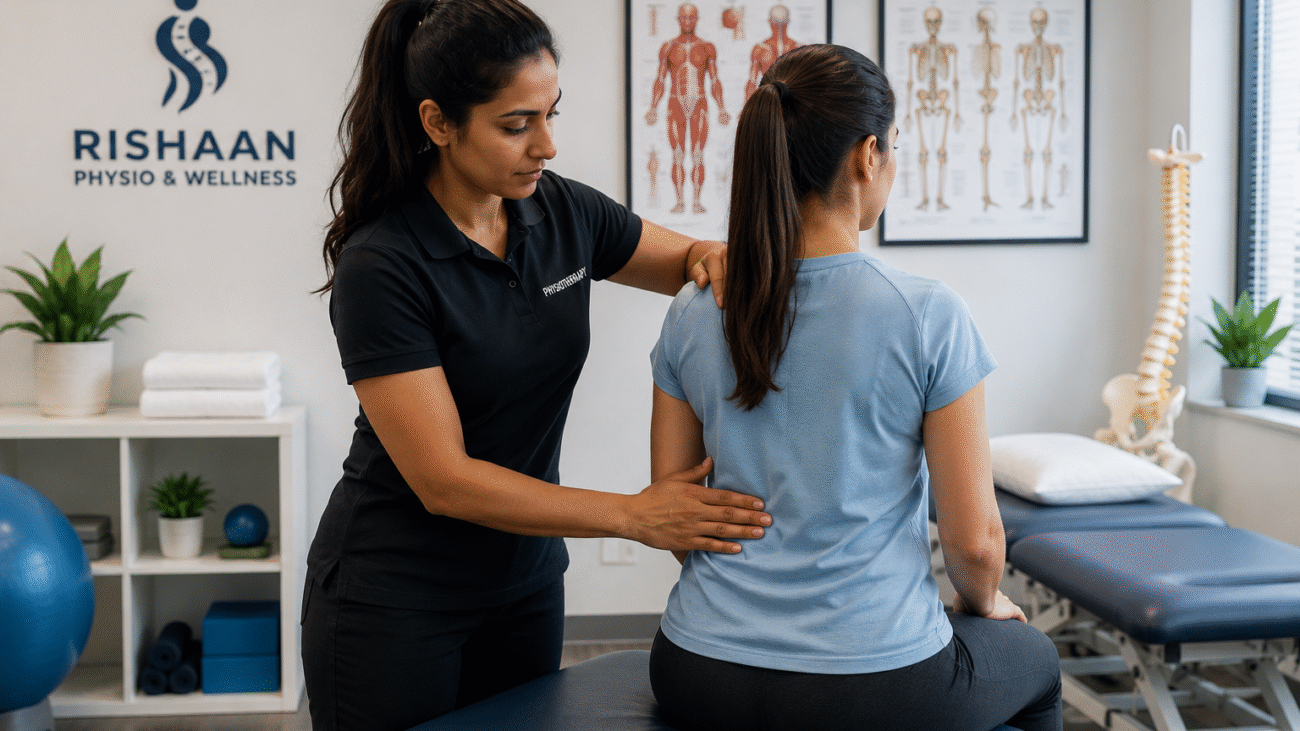
Your physiotherapist conducts a comprehensive postural analysis — photographing and measuring your standing and seated posture, assessing muscle length, strength, and joint mobility — to identify your specific pattern of dysfunction. Not all “bad posture” is the same; treatment must target your particular imbalances.
- Cervical joint mobilisation: Restores mobility to stiff upper cervical joints
- Thoracic spine mobilisation/manipulation: Opens up the kyphotic mid-back and improves thoracic extension
- Pectoral and anterior shoulder stretching: Releases shortened chest muscles
- Hip flexor manual release: Addresses psoas tightness contributing to anterior pelvic tilt
CORRECTIVE EXERCISE PROGRAM
The cornerstone of posture correction. Your program will include:
For the cervical spine:
- Deep cervical flexor activation (chin tucks)
- Cervical retraction exercises
- Neck flexor endurance training
For the thoracic spine and shoulders:
- Thoracic extension over a foam roller or chair
- Scapular retraction and depression exercises
- Wall slides and YTW exercises for lower trapezius
- Chest opening stretches
For the lower back and hips:
- Hip flexor stretching (Thomas stretch, kneeling hip flexor)
- Glute activation (bridges, clamshells, single-leg deadlifts)
- Core stability (dead bugs, bird dogs, plank progressions)
- Posterior pelvic tilt training
Chronic postural muscles — particularly the upper trapezius, levator scapulae, and suboccipital muscles — develop dense trigger points that resist manual therapy alone. IMS at Rishaan Physio provides rapid release of these trigger points, allowing the corrective exercises to work more effectively.
ERGONOMIC ASSESSMENT AND WORKPLACE ADVICE
The most effective posture correction program is undermined if you return to a poorly set-up workstation for 8 hours every day. Your physiotherapist will provide specific ergonomic recommendations:
MONITOR HEIGHT: Top of screen at or slightly below eye level. Avoids both forward head (screen too low) and neck extension (screen too high).
MONITOR DISTANCE: Arm’s length away (approximately 50–70 cm). Prevents eye strain and forward reaching.
CHAIR HEIGHT: Hips at 90° or slightly open. Thighs parallel to ground. Feet flat on floor.
LUMBAR SUPPORT: Use a lumbar roll or rolled towel in the curve of the lower back if your chair lacks adequate support.
KEYBOARD AND MOUSE: Elbows at 90°, shoulders relaxed. Mouse close to body — reaching for a distant mouse chronically shortens the shoulder.
MOVEMENT BREAKS: Set a timer for every 30–45 minutes. Stand, walk briefly, perform 2–3 postural exercises (chin tucks, shoulder rolls, hip flexor stretch). Posture is dynamic — no static position, however “correct,” is beneficial for more than 30–45 minutes continuously.
HOW LONG DOES POSTURE CORRECTION TAKE?
This is highly individual, but as a general guide:
- Pain relief: Often within 2–4 weeks of consistent treatment
- Measurable postural improvements: 6–12 weeks of consistent exercise
- Lasting correction: 3–6 months with consistent daily exercise and ergonomic modification
Posture correction is a process, not a treatment. The physiotherapy program gives you the tools — the consistency you apply determines the long-term outcome.
FREQUENTLY ASKED QUESTIONS
Q: Can physiotherapy actually correct years of bad posture?
A: Yes — but “correct” should be understood as “significantly improve” rather than “return to perfect.” The musculoskeletal system is remarkably adaptable. Consistent, targeted exercise over 3–6 months produces meaningful, measurable posture improvements even after years of dysfunction.
Q: Are standing desks the solution to posture problems?
A: Standing desks help by adding postural variety, but standing all day is as harmful as sitting all day — both in the same position for hours. The solution is movement variability: sit for 45 minutes, stand for 15, move briefly. A sit-stand desk is a useful tool, but it doesn’t replace physiotherapy and movement.
Q: How do I know if my posture is causing my headaches?
A: If your headaches start at the base of the skull, worsen through the day (especially after hours at a desk), are located at the back of the head and temples, and ease briefly with neck stretching — they are very likely cervicogenic (neck-sourced) headaches related to postural dysfunction.
Q: Can my child or teenager have posture correction physiotherapy?
A: Yes. Adolescent posture problems — driven by school desk work, phone use, and heavy backpacks — respond very quickly to physiotherapy because the musculoskeletal system is still highly adaptable. Early intervention prevents the establishment of chronic adult patterns.
Q: Do I need a referral from my doctor for posture correction physiotherapy?
A: No. You can book directly at Rishaan Physio in Mississauga without a physician referral.
BOOK YOUR POSTURE ASSESSMENT IN MISSISSAUGA
Stop managing your posture symptoms. Start correcting the cause.
Rishaan Physio & Wellness Clinic
5105 Hurontario St, Unit 7, Mississauga, ON
Phone: (905) 800-1661
Website: rishaanphysio.com
Open 7 days a week | Free pickup & drop-off available