
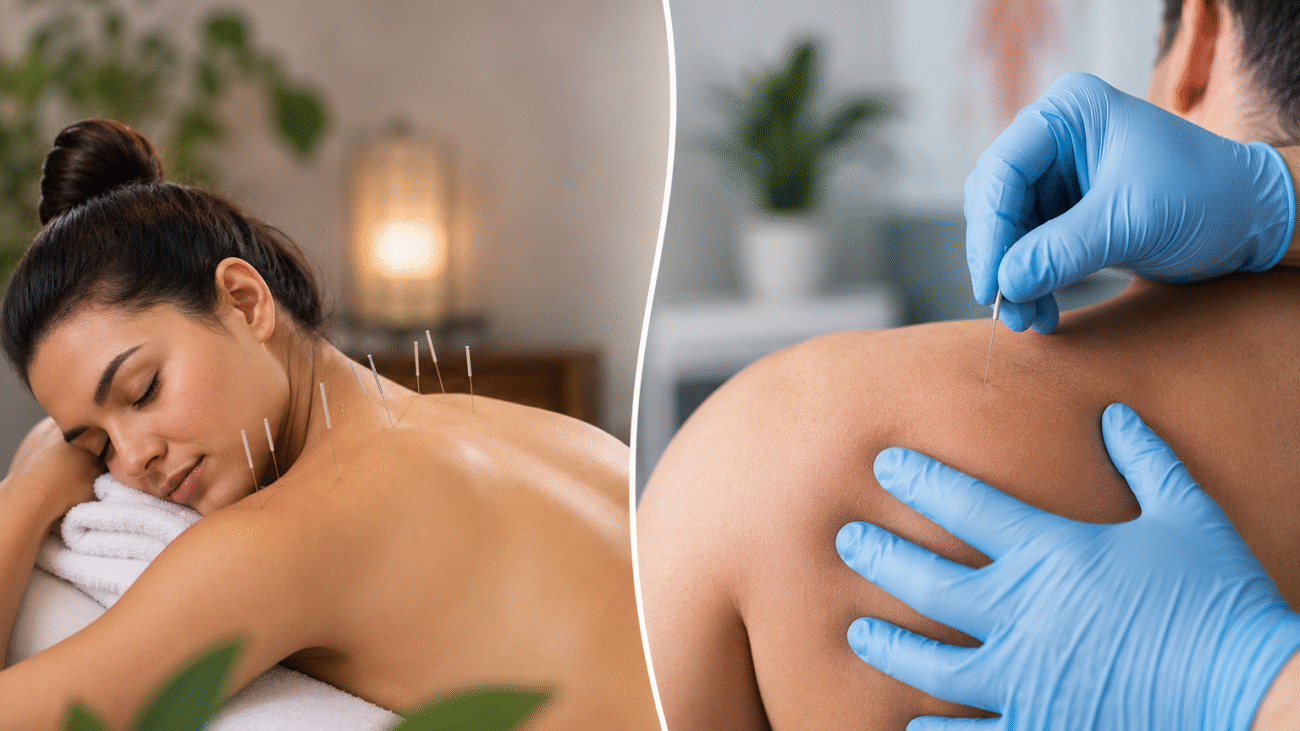
Two techniques. Both use fine needles. Both relieve pain. Yet acupuncture and dry needling are distinct practices rooted in entirely different theoretical frameworks and clinical approaches.
If you’ve been told you might benefit from one or the other — or you’re simply curious about the difference — this guide from Rishaan Physio & Wellness Clinic in Mississauga will give you a clear, honest comparison.
WHAT IS TRADITIONAL ACUPUNCTURE?
Acupuncture is a practice with roots in Traditional Chinese Medicine (TCM) dating back over 2,000 years. It is based on the concept of qi (life energy) flowing through meridians — specific pathways throughout the body. When qi flow is disrupted or blocked, pain and disease result. Needles inserted at specific acupuncture points along these meridians are believed to restore the flow of qi and bring the body back into balance.
Modern research has provided physiological explanations for acupuncture’s effects that complement the traditional framework:
- Stimulation of endorphin and serotonin release
- Modulation of the central nervous system’s pain processing
- Anti-inflammatory effects through cytokine regulation
- Improved local blood circulation
WHAT TRADITIONAL ACUPUNCTURE TREATS:
Acupuncture has demonstrated effectiveness for a wide range of conditions, including:
- Chronic pain (back, neck, knee, shoulder)
- Headaches and migraines
- Anxiety and stress
- Insomnia
- Digestive disorders
- Nausea (including chemotherapy-related nausea)
- Reproductive health conditions
- Fatigue
WHAT IS DRY NEEDLING?
Dry needling is a modern, Western physiotherapy technique that uses the same fine filament needles as acupuncture but is based on anatomy, neurophysiology, and musculoskeletal science rather than TCM theory.
Specifically, dry needling targets myofascial trigger points — tight, hypersensitive bands within muscle tissue (“knots”) that cause local pain and referred pain patterns. The needle is inserted directly into the trigger point, producing a “local twitch response” — an involuntary muscle contraction that resets the neuromuscular junction, releases the trigger point, and reduces pain.
At Rishaan Physio, dry needling is performed by registered physiotherapists who have completed post-graduate training in intramuscular stimulation (IMS) — a specific form of dry needling developed by Dr. Chan Gunn at the University of British Columbia.
WHAT DRY NEEDLING TREATS:
Dry needling is specifically effective for:
- Myofascial pain syndrome (trigger points)
- Chronic neck and back pain
- Tension headaches and cervicogenic headaches
- Shoulder pain (rotator cuff, impingement)
- IT band syndrome
- Piriformis syndrome and sciatic pain
- Tennis elbow and golfer’s elbow
- Post-surgical muscle guarding
- Chronic pain with a significant muscular component
KEY DIFFERENCES: SIDE BY SIDE
THEORETICAL BASIS
Acupuncture: Traditional Chinese Medicine — meridians, qi, energy balance
Dry Needling: Western anatomy and neurophysiology — trigger points, neuromuscular function
NEEDLE PLACEMENT
Acupuncture: Specific acupuncture points on meridian pathways (may be distant from the site of pain)
Dry Needling: Directly into myofascial trigger points in affected muscles
TARGET
Acupuncture: Systemic regulation — multiple body systems, not just pain
Dry Needling: Localised muscular dysfunction and pain
SENSATION DURING TREATMENT
Acupuncture: Dull ache (de qi) — often deeply relaxing
Dry Needling: Local twitch response — brief intense muscle cramp/twitch, followed by relaxation
TRAINING
Acupuncture: Provided by TCM practitioners (CTCMPAO regulated in Ontario) or physiotherapists with acupuncture training
Dry Needling/IMS: Provided by physiotherapists or other regulated health professionals with post-graduate needle therapy training
CONDITIONS TREATED
Acupuncture: Broader — pain, anxiety, insomnia, digestive issues, hormonal conditions, nausea
Dry Needling: More specific — musculoskeletal pain with trigger point component
NUMBER OF NEEDLES
Acupuncture: Typically 10–20 needles, retained for 20–30 minutes
Dry Needling: Fewer needles, shorter retention — often in and out within seconds per point
WHICH SHOULD YOU CHOOSE?
FOR MUSCULOSKELETAL PAIN WITH A CLEAR TRIGGER POINT COMPONENT
Choose dry needling (IMS). If you have a specific area of muscle tightness, a knot that won’t release, or referred pain from a trigger point, dry needling provides faster, more targeted relief for this mechanism.
FOR CHRONIC PAIN WITH ANXIETY, SLEEP ISSUES, OR SYSTEMIC SYMPTOMS
Choose acupuncture. If your pain is accompanied by high stress, poor sleep, digestive issues, or other systemic complaints, acupuncture addresses the whole-body dimension that dry needling does not.
FOR HEADACHES AND NECK PAIN
Either — or both. Cervicogenic headaches with muscle trigger point components respond very well to dry needling. Migraine and tension headaches with systemic components may respond better to acupuncture, or a combination of both.
FOR POST-SURGICAL MUSCLE GUARDING
Choose dry needling. Muscles that have gone into protective spasm after surgery respond well to IMS at Rishaan Physio.
THE GOOD NEWS: You don’t always have to choose.
At Rishaan Physio in Mississauga, our team includes practitioners trained in both acupuncture and IMS/dry needling. Depending on your assessment findings, your physiotherapist may incorporate elements of both approaches in a single treatment plan.
IS THERE A DIFFERENCE IN HOW THEY FEEL?
Yes — and this is important to understand:
Acupuncture typically feels relaxing. The sensation during needle retention (de qi) is a dull, heavy ache that most patients find deeply calming. Many patients fall asleep during acupuncture sessions.
Dry needling is more intense in the moment. The local twitch response is a brief, involuntary muscle cramp that can feel surprising or uncomfortable for a second — but is followed almost immediately by a deep muscle release. Post-treatment soreness (like post-workout muscle ache) is common for 24–48 hours and is a sign that the technique is working.
FREQUENTLY ASKED QUESTIONS
Q: Is dry needling the same as acupuncture?
A: No — they use the same type of needle but are entirely different in theory, technique, and target. Acupuncture follows TCM meridian theory; dry needling follows Western neuromuscular anatomy and targets trigger points.
Q: Are both safe?
A: Yes — both are safe when performed by trained, regulated practitioners using sterile, single-use needles. At Rishaan Physio, all needle therapies are performed under strict infection control protocols.
Q: Is dry needling painful?
A: The local twitch response feels like a brief, intense muscle cramp — most patients describe it as strange rather than painful. The duration is typically less than a second. Post-treatment muscle soreness for 24–48 hours is normal.
Q: Which one is covered by insurance?
A: Both are typically covered under extended health insurance. Acupuncture by a registered acupuncturist is covered under acupuncture benefits. Dry needling performed as part of physiotherapy is covered under physiotherapy benefits. Check your specific plan.
Q: How many sessions will I need?
A: Most patients see meaningful improvement in 4–6 sessions of dry needling for trigger point conditions. Acupuncture for systemic conditions typically requires 8–10 sessions for a full course.
BOOK YOUR NEEDLE THERAPY CONSULTATION IN MISSISSAUGA
Not sure which is right for you? Book an assessment at Rishaan Physio — our team will assess your condition and recommend the most appropriate approach.
Rishaan Physio & Wellness Clinic
5105 Hurontario St, Unit 7, Mississauga, ON
Phone: (905) 800-1661
Website: rishaanphysio.com
Open 7 days a week | Free pickup & drop-off