

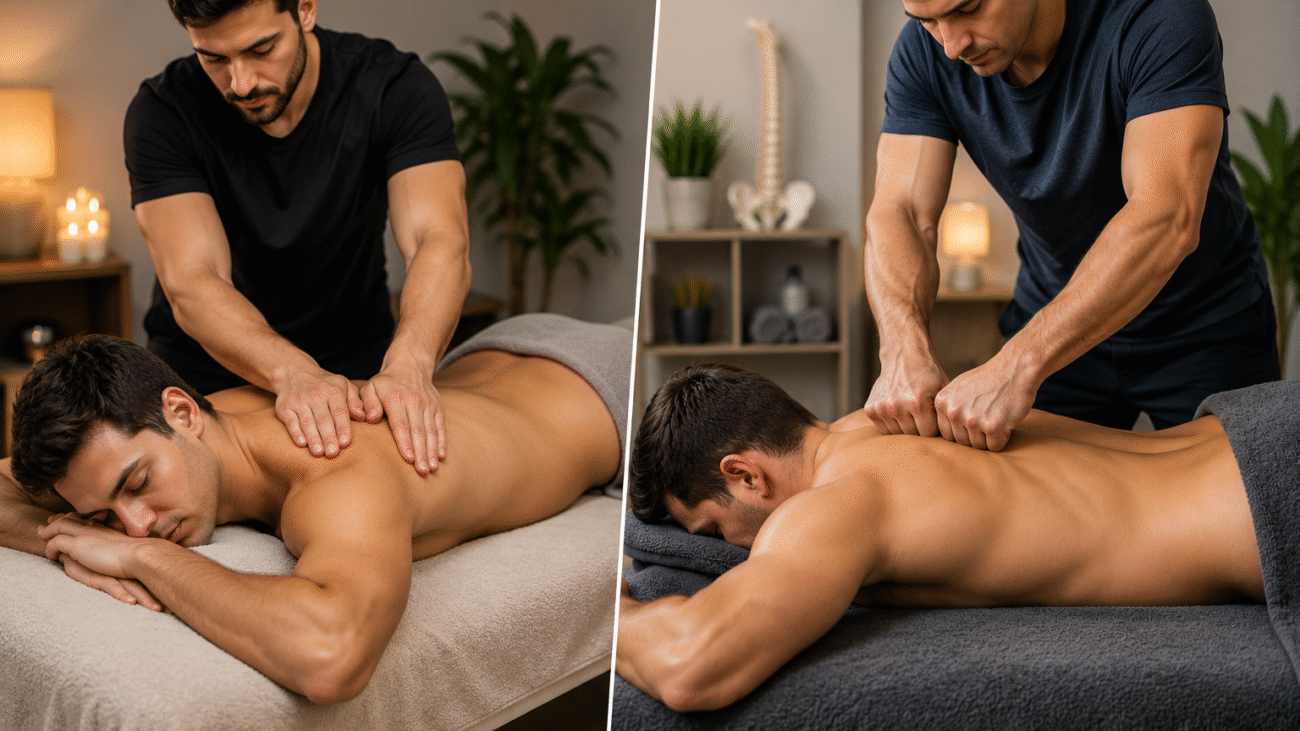
You’ve decided to book a massage therapy appointment — and then you see the question: deep tissue or Swedish?
If you’re not sure what the difference is, you’re not alone. Many people pick one at random, or always choose the same type out of habit, without knowing whether it’s actually the best fit for their needs.
At Rishaan Physio & Wellness Clinic in Mississauga, our Registered Massage Therapists (RMTs) work with patients across the full spectrum — from athletes with deep muscle injuries to busy professionals seeking stress relief. Here’s a practical guide to both massage types so you can make an informed choice.
SWEDISH MASSAGE: THE FOUNDATION
Swedish massage is the most widely practiced form of therapeutic massage in North America. It was developed in the early 19th century by Swedish physiologist Per Henrik Ling and forms the foundation upon which most other massage modalities are built.
TECHNIQUES USED:
- Effleurage: Long, gliding strokes along the length of muscle fibers, moving toward the heart. Used for warming tissue, increasing circulation, and relaxation.
- Petrissage: Kneading, squeezing, and rolling of soft tissue. Targets superficial muscle layer to release tension.
- Tapotement: Light rhythmic tapping or cupping. Stimulates circulation and muscle tone.
- Friction: Circular rubbing motions. Loosens superficial adhesions.
- Vibration: Oscillating movements to relax specific muscle groups.
PRESSURE: Light to moderate. Swedish massage can be customised for sensitivity preference but generally works on superficial muscle layers and does not apply deep sustained pressure.
WHAT SWEDISH MASSAGE IS BEST FOR:
- General relaxation and stress relief
- Improving circulation and lymphatic flow
- Mild muscle tension and fatigue
- First-time massage recipients
- Clients with high stress, anxiety, or insomnia
- Recovery during illness or post-fatigue
- Prenatal massage (with appropriate modifications)
- General wellbeing maintenance
DEEP TISSUE MASSAGE: FOR CHRONIC PAIN AND STRUCTURAL PROBLEMS
Deep tissue massage uses many of the same techniques as Swedish massage, but with significantly more sustained pressure and a focus on the deeper layers of muscle tissue, tendons, and fascia.
The goal of deep tissue massage is to reach beyond the superficial muscles to address chronic tension patterns, adhesions (scar tissue), and myofascial restrictions that Swedish massage cannot adequately affect.
TECHNIQUES USED:
- Sustained deep compression: Slow, deliberate pressure applied directly to areas of chronic tension
- Cross-fibre friction: Pressure applied perpendicular to muscle fibres to break down adhesions
- Trigger point release: Sustained pressure on tight muscle knots until they release
- Myofascial release: Slow, sustained stretching of the fascia surrounding muscles
- Stripping: Deep gliding pressure along muscle fibres to elongate and release
PRESSURE: Moderate to deep. It should feel intense — “good pain” — but should never cause sharp pain, bruising, or lingering discomfort beyond 48 hours. Communication with your therapist during the session is essential.
WHAT DEEP TISSUE MASSAGE IS BEST FOR:
- Chronic muscle pain and tightness (neck, upper back, lower back)
- Sports injuries and overuse injuries (IT band, rotator cuff, hip flexors)
- Post-accident recovery (whiplash, soft tissue injuries)
- Repetitive strain injuries (carpal tunnel, tennis elbow)
- Scar tissue and post-surgical adhesions
- Poor posture and structural muscular imbalances
- Plantar fasciitis and Achilles tendinopathy
- Athletes seeking performance recovery
KEY DIFFERENCES: AT A GLANCE
PRESSURE
Swedish: Light to moderate
Deep Tissue: Moderate to firm/deep
TARGET LAYER
Swedish: Superficial muscles, circulation
Deep Tissue: Deep muscle layers, fascia, adhesions
PRIMARY GOAL
Swedish: Relaxation, circulation, general wellbeing
Deep Tissue: Treatment of chronic pain, structural dysfunction, adhesions
SENSATION DURING TREATMENT
Swedish: Relaxing, comfortable throughout
Deep Tissue: Intense in areas of tension — “therapeutic discomfort”
POST-TREATMENT SORENESS
Swedish: Minimal — feel lighter and more relaxed
Deep Tissue: Mild soreness for 24–48 hours is normal and expected
BEST FOR
Swedish: Stress, mild tension, relaxation, general maintenance
Deep Tissue: Chronic pain, sports injuries, structural problems, adhesions
WHICH ONE SHOULD YOU CHOOSE?
CHOOSE SWEDISH IF:
- You are primarily seeking relaxation and stress relief
- You have no specific musculoskeletal complaints
- You are sensitive to deep pressure
- It is your first massage
- You are pregnant (standard prenatal protocol applies)
- You are recovering from illness or experiencing high fatigue
CHOOSE DEEP TISSUE IF:
- You have specific areas of chronic pain or muscle tightness
- You have a sports injury, repetitive strain, or postural dysfunction
- You have been told you have trigger points or myofascial tightness
- You regularly feel stiffness that Swedish massage doesn’t adequately resolve
- You are an athlete seeking performance and recovery support
CHOOSING BOTH — THE INTEGRATIVE APPROACH
Many patients benefit from an integrative session that begins with Swedish techniques to warm up the tissue and promote relaxation, then transitions into targeted deep tissue work on problem areas, and finishes with Swedish strokes to restore circulation and promote healing.
At Rishaan Physio in Mississauga, our RMTs are trained to seamlessly integrate both approaches based on your assessment findings and preferences. You don’t have to choose one or the other — a skilled therapist adapts throughout the session.
WHAT TO TELL YOUR MASSAGE THERAPIST
Before your session, communicate:
- Where you are experiencing pain or tightness (be specific)
- Your pressure preference (you can always ask for more or less during the session)
- Any recent injuries, surgeries, or medical conditions
- Whether you bruise easily or have sensitive skin
- What outcome you are hoping for — relaxation vs. treatment
A good RMT will check in with you throughout the session to ensure pressure is appropriate. Never tolerate pain that feels sharp, burning, or wrong — speak up immediately.
FREQUENTLY ASKED QUESTIONS
Q: Is deep tissue massage safe for everyone?
A: Deep tissue massage is not recommended for people with blood clots, bleeding disorders, osteoporosis, recent fractures, active skin infections, or certain cancers. Pregnant women should not receive deep pressure on the abdomen. Always complete a full intake form and disclose medical conditions before your session.
Q: Will deep tissue massage fix my chronic back pain?
A: Deep tissue massage is a powerful tool for addressing the muscular component of back pain — releasing tight muscles, breaking down adhesions, and reducing pain. However, for complex or structural back conditions (disc herniation, spondylosis), it works best as part of a physiotherapy-directed treatment plan.
Q: How long should my massage session be?
A: For Swedish relaxation: 60 minutes is typically sufficient. For deep tissue with multiple problem areas: 75–90 minutes allows adequate time without rushing. For a focused problem area only: 45–60 minutes.
Q: How often should I get massage therapy?
A: For general wellness: monthly. For active treatment of a specific condition: weekly or bi-weekly initially, tapering as improvement occurs. Your RMT will recommend a frequency based on your goals and findings.
Q: Is massage therapy covered by insurance in Ontario?
A: Yes — registered massage therapy (RMT) services are covered by most extended health insurance plans in Ontario. Coverage amounts typically range from $300–$600 per year. At Rishaan Physio, we provide RMT receipts for insurance reimbursement and offer direct billing for most major plans.
BOOK YOUR MASSAGE THERAPY APPOINTMENT IN MISSISSAUGA
Rishaan Physio & Wellness Clinic
5105 Hurontario St, Unit 7, Mississauga, ON
Phone: (905) 800-1661
Website: rishaanphysio.com
Open 7 days a week | Free pickup & drop-off available