

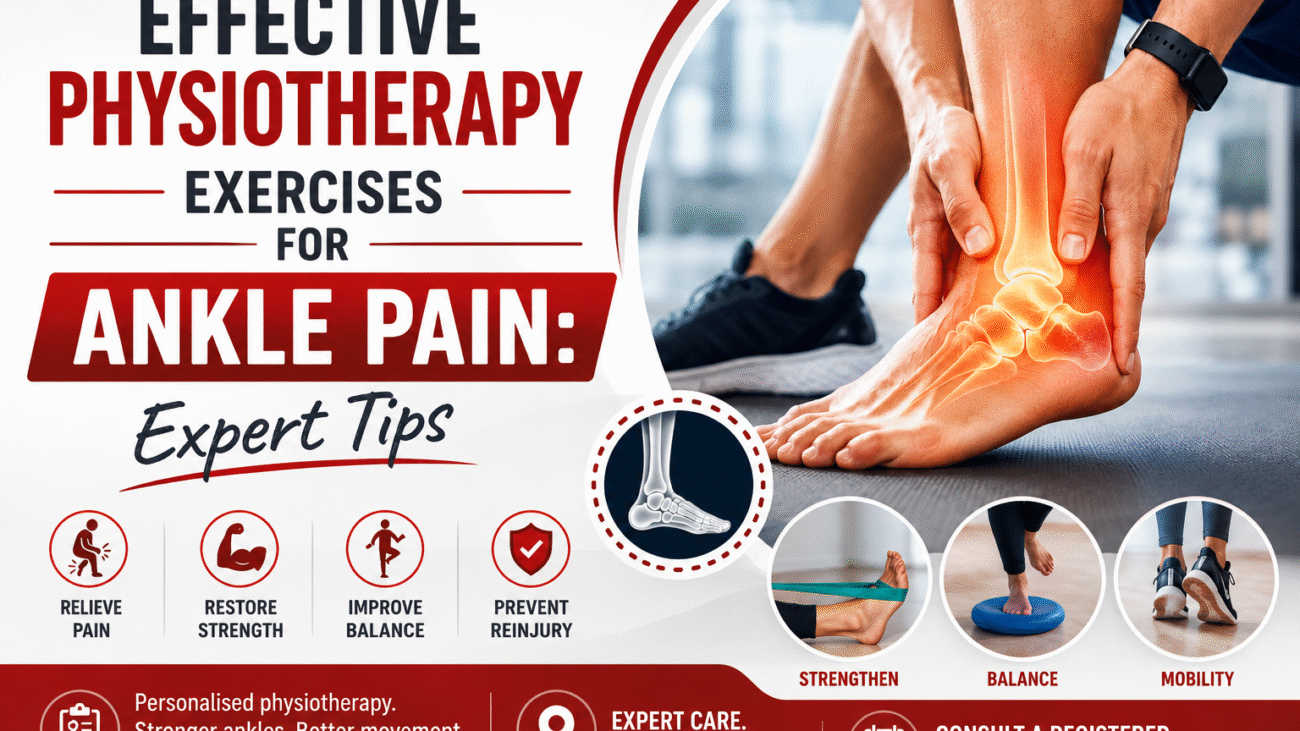
Ankle pain is one of the most common musculoskeletal complaints among Mississauga residents — whether you’re a recreational runner at Erindale Park, an office worker dealing with chronic stiffness, or someone recovering from a sprain. Whatever the cause, the good news is that physiotherapy exercises for ankle pain are among the most effective, evidence-based tools for recovery, strength restoration, and preventing reinjury.
At Rishaan Physio Wellness Clinic in Mississauga, our registered physiotherapists design personalised ankle rehabilitation programs tailored to your specific condition, activity level, and goals. This guide walks you through expert-recommended exercises and the reasoning behind each — so you can understand not just what to do, but why it works.
Understanding Ankle Pain: Common Causes in Mississauga Patients
Before diving into exercises, it’s important to understand what’s typically driving ankle pain. The most common causes we see at our Mississauga physiotherapy clinic include:
- Lateral ankle sprains – The most frequent sports and activity-related ankle injury, involving overstretching or tearing of the lateral ligaments (ATFL, CFL)
- Achilles tendinopathy – Degeneration or irritation of the Achilles tendon, often caused by overuse or sudden increases in training load
- Ankle osteoarthritis – Gradual cartilage breakdown causing chronic pain, stiffness, and swelling, especially in older adults
- Peroneal tendon injuries – Affecting the tendons along the outer ankle, often from repetitive overuse or ankle instability
- Posterior tibial tendon dysfunction (PTTD) – A progressive condition causing flat-foot deformity and inner ankle pain
- Chronic ankle instability – Repeated sprains leading to ongoing joint instability and “giving way”
Each condition responds differently to rehabilitation. A proper assessment by a Mississauga physiotherapist is always recommended before beginning any exercise program — particularly if you are post-injury or post-surgical.
The 4 Pillars of Ankle Rehabilitation
Effective ankle physiotherapy is built on four core principles. Every exercise recommended by our Mississauga physio team falls into one or more of these categories:
- Range of motion (ROM) restoration – Recovering full joint mobility after injury or stiffness
- Strength training – Rebuilding the muscles and tendons that stabilise the ankle
- Proprioception and balance – Retraining the ankle’s neuromuscular control to prevent reinjury
- Functional movement – Progressing to activities that mimic real-life demands (walking, running, sport)
Phase 1: Early Mobility Exercises (Acute to Sub-Acute Stage)
In the early stages of ankle pain or immediately following a sprain (typically Days 1–7), the goal is to manage swelling, protect healing tissue, and gently restore range of motion without aggravating the injury.
1. Ankle Alphabet
Sit in a chair with your foot elevated slightly off the floor. Using your big toe as a “pen,” trace each letter of the alphabet in the air. Move only through your ankle — not your entire leg.
Why it works: This exercise moves the ankle through its full range of motion in multiple planes, promoting circulation, reducing stiffness, and maintaining joint mobility without placing load through the healing tissues. It’s one of the gentlest and most effective early-stage exercises for any ankle condition.
Sets/Reps: 1–2 times daily, full alphabet each time
2. Towel Ankle Circles and Pumps
With your heel resting on a rolled towel, slowly pump your foot up (dorsiflexion) and down (plantarflexion), then perform slow controlled circles clockwise and counterclockwise.
Why it works: Gentle, repetitive motion activates the calf muscle pump, which helps drain excess fluid from the ankle and reduces post-injury swelling. This is particularly valuable in the first 48–72 hours after a sprain.
Sets/Reps: 3 sets of 20 pumps, 10 circles each direction, 2–3 times daily
3. Seated Towel Stretch (Plantar Fascia and Calf)
Sit on the floor with your leg straight. Loop a towel or resistance band around the ball of your foot and gently pull back, keeping your knee straight. Hold for 20–30 seconds.
Why it works: This targets the gastrocnemius and soleus (calf muscles) as well as the Achilles tendon. Tight calves are one of the most common contributing factors to ankle pain, Achilles tendinopathy, and plantar fasciitis. Early, gentle stretching helps restore dorsiflexion range of motion — critical for normal walking mechanics.
Sets/Reps: 3 x 30-second holds, 2–3 times daily
Phase 2: Strengthening Exercises (Sub-Acute to Rehabilitation Stage)
Once swelling and acute pain have subsided (typically 1–3 weeks post-injury depending on severity), the focus shifts to rebuilding strength in the muscles that support and stabilise the ankle joint.
4. Resistance Band Ankle Eversion and Inversion
Anchor a resistance band to a fixed object and loop it around your foot. Sit with your leg extended and slowly move your foot inward (inversion) or outward (eversion) against the band resistance. Control the movement in both directions.
Why it works: Lateral ankle sprains commonly damage the peroneal muscles (responsible for eversion). Weakness in these muscles is a primary risk factor for reinjury and chronic instability. Resistance band exercises rebuild peroneal and tibialis posterior strength in a controlled, progressive manner — making them essential for anyone who has experienced a sprain in Mississauga or beyond.
Sets/Reps: 3 sets of 15–20 reps each direction, 5–6 days/week
5. Calf Raises (Double-Leg, then Single-Leg)
Stand with feet hip-width apart near a wall or chair for balance support. Slowly rise onto the balls of both feet, pause at the top for 2 seconds, then lower with control over 3 seconds. Once this is pain-free and easy, progress to single-leg calf raises.
Why it works: The gastrocnemius and soleus are the primary movers of plantarflexion and critical stabilisers of the ankle and foot. Calf strength is directly correlated with Achilles tendon load capacity, ankle joint stability, and walking/running efficiency. The slow lowering (eccentric) component is especially important for Achilles tendinopathy rehabilitation, as eccentric loading has strong clinical evidence for tendon remodelling.
Sets/Reps: 3 sets of 15 (double-leg) progressing to 3 x 12–15 (single-leg)
6. Toe Scrunches and Marble Pickups
Place a small towel flat on the floor. Using only your toes, scrunch it toward you and then spread it back out. Alternatively, place marbles on the floor and pick them up with your toes, transferring them to a cup.
Why it works: Intrinsic foot muscles — the small muscles within the foot itself — play an enormous role in foot arch support, load distribution, and ankle stability. These muscles are often neglected in traditional gym training and significantly weakened after ankle injuries. Strengthening them helps address conditions like PTTD, plantar fasciitis, and chronic ankle instability.
Sets/Reps: 2–3 sets of 30 scrunches or 10 marble pickups, twice daily
Phase 3: Proprioception and Balance Training
Proprioception — your body’s ability to sense joint position and movement — is dramatically impaired after an ankle sprain. Research shows that poor proprioception is the number one risk factor for re-spraining an ankle. This phase is critical and is often under-emphasised in non-specialist rehabilitation.
7. Single-Leg Stand Progressions
Stand on one foot near a wall for safety. Progress through stages: eyes open on firm surface → eyes closed on firm surface → eyes open on unstable surface (folded towel or wobble board) → eyes closed on unstable surface.
Why it works: Each progression increases the demand on the ankle’s sensory receptors (mechanoreceptors in the joint capsule and ligaments). By removing visual cues and introducing instability, you force the ankle and its surrounding musculature to respond more rapidly and accurately to positional changes — directly reducing sprain risk.
Sets/Reps: 3 x 30 seconds per leg, progressing over 4–6 weeks
8. Wobble Board or BOSU Ball Training
Stand on a wobble board or BOSU ball (flat side up for greater challenge). Maintain balance while performing controlled circles with the board. Progress to single-leg standing, then add upper body movements (catching a ball, reaching in different directions).
Why it works: Unstable surface training has strong clinical evidence for reducing the risk of chronic ankle instability in athletes and active individuals. It challenges the entire kinetic chain — from foot to core — and is highly applicable to the demands of recreational sport in Mississauga. Our physiotherapy team frequently incorporates this into return-to-sport programs.
Sets/Reps: 3 x 60 seconds, 4–5 days/week
Phase 4: Functional and Sport-Specific Exercises
The final phase bridges the gap between clinic-based rehabilitation and real-world activity. These exercises should only be introduced when you can perform single-leg calf raises and balance work pain-free and with good control.
9. Lateral Band Walks
Place a resistance band around both ankles. Stand in a slight squat position and take controlled side-steps, maintaining tension in the band throughout. Take 10–15 steps in each direction.
Why it works: This exercise simultaneously strengthens the hip abductors, knee stabilisers, and ankle evertors — the entire lateral chain that protects the ankle during dynamic, multi-directional movement. It’s a staple exercise in our Mississauga sports physiotherapy programs for runners and court sport athletes.
Sets/Reps: 3 x 15 steps each direction
10. Hopping and Jump Progressions
Begin with double-leg hops in place, then progress to single-leg hops forward/backward, side-to-side, and finally in a figure-8 pattern. Land softly with a slight knee bend, absorbing impact through the full leg rather than just the ankle.
Why it works: For athletes and active Mississauga residents, plyometric loading is essential for retraining the ankle’s ability to handle dynamic impact forces. Introducing it gradually allows the Achilles tendon, ligaments, and surrounding muscles to adapt to sport-specific demands — the final step before a full return to activity.
Sets/Reps: 3 x 10–15 hops per pattern, introduced only when previous phases are complete
Additional Physiotherapy Treatments for Ankle Pain in Mississauga
Exercise is the backbone of ankle rehabilitation, but it works best as part of a comprehensive treatment approach. At Rishaan Physio in Mississauga, we often combine exercise therapy with:
- Manual therapy – Joint mobilisations to restore full ankle range of motion and reduce stiffness, especially in post-sprain or arthritic ankles
- Registered Massage Therapy (RMT) – Deep tissue massage and myofascial release to address calf tightness, Achilles adhesions, and peroneal tension that restrict ankle mobility
- Acupuncture – Dry needling to the calf, peroneals, and Achilles can significantly reduce pain, promote tissue healing, and address chronic tendon pain
- Custom Orthotics – For patients with biomechanical contributors such as overpronation, flat feet, or leg length discrepancy, custom orthotics provide essential structural support and load redistribution
- Taping and bracing – Kinesiology taping and ankle bracing offer external proprioceptive support during the transition back to activity
If you’re also experiencing knee or hip pain alongside your ankle problems, our article on Physiotherapy for Knee Pain in Mississauga provides additional insight into how the lower limb kinetic chain affects overall movement health.
When to See a Physiotherapist for Ankle Pain in Mississauga
While mild ankle soreness from overuse can often be self-managed with rest and gentle movement, you should book an appointment with a Mississauga physiotherapist if you experience any of the following:
- Significant swelling, bruising, or inability to bear weight after an injury (rule out fracture first)
- Pain that has persisted for more than 2–3 weeks without improvement
- Recurring ankle sprains or a feeling that the ankle “gives way”
- Achilles tendon pain that worsens with activity and stiffness that is worst first thing in the morning
- Inner ankle pain that is affecting your arch and causing your foot to roll inward progressively
- Ankle pain affecting your ability to exercise, work, or carry out daily activities
Early physiotherapy intervention consistently leads to faster recovery, fewer complications, and a lower risk of chronic ankle instability. Don’t wait for ankle pain to become a chronic problem — the earlier you start targeted rehabilitation, the better your outcome.
Tips for Exercising Safely with Ankle Pain
Regardless of which phase of rehabilitation you’re in, the following principles will help you exercise safely and get the most out of your ankle physiotherapy program:
- Warm up first – 5–10 minutes of light walking or cycling gets circulation going and prepares the joint for exercise
- Work within a pain-free range – Mild discomfort (3/10 or below) during strengthening is acceptable; sharp, stabbing pain is not
- Progress gradually – Increase reps, sets, or resistance only when you can complete the current level comfortably for 2–3 sessions
- Ice after exercise if swollen – 15–20 minutes of ice application post-exercise helps manage any reactive swelling
- Wear appropriate footwear – Supportive shoes with adequate heel counter and cushioning significantly reduce ankle stress during rehabilitation exercises
- Rest and recover – Give your body 24–48 hours between strengthening sessions to allow tissue adaptation
Book Your Ankle Pain Assessment at Rishaan Physio, Mississauga
Ankle pain doesn’t have to sideline you. With the right physiotherapy exercises, hands-on treatment, and expert guidance from a registered physiotherapist in Mississauga, you can recover fully and return to the activities you love — whether that’s recreational sports, daily walks, or simply getting through the day without discomfort.
At Rishaan Physio Wellness Clinic, we offer comprehensive ankle pain assessments and personalised rehabilitation programs designed for Mississauga residents of all ages and activity levels. Our clinic is open 7 days a week, with free pickup and drop-off services for your convenience.
Take the first step toward pain-free movement. Contact Rishaan Physio today to book your ankle pain assessment and get a customised treatment plan that gets you back on your feet — faster.