

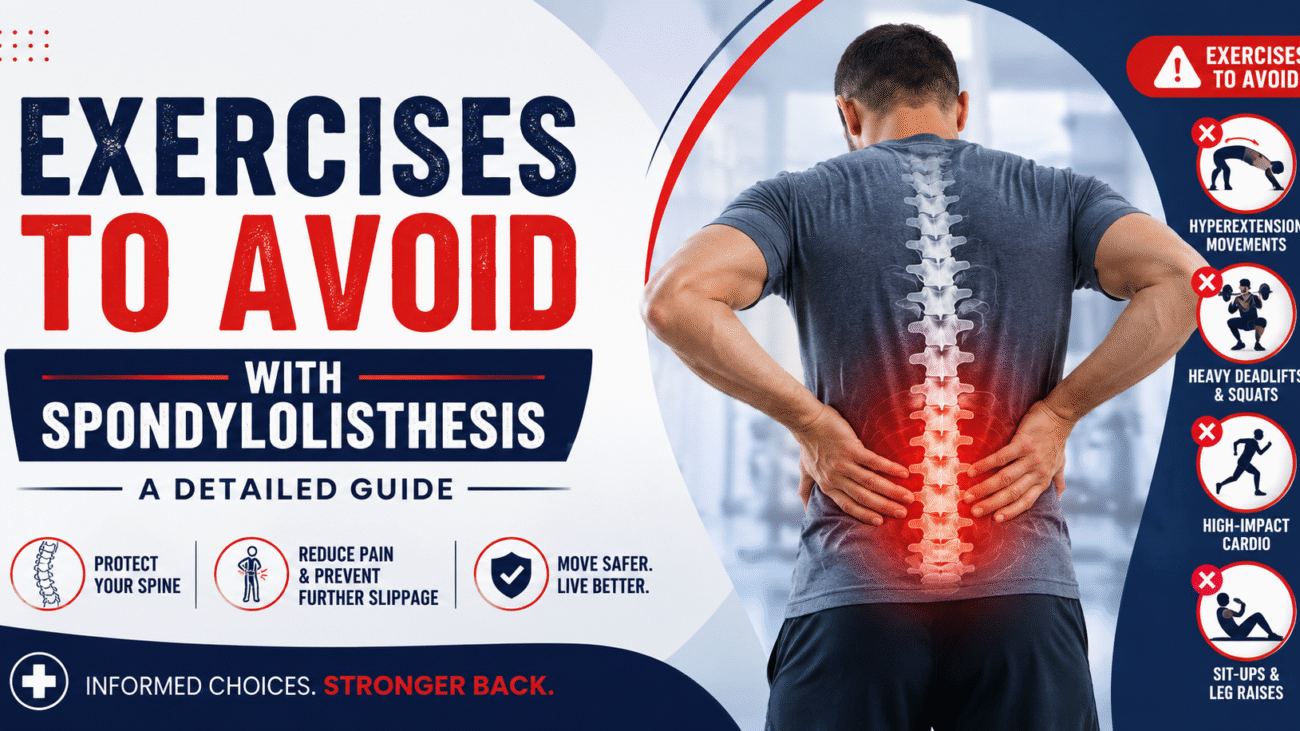
If you’ve been diagnosed with spondylolisthesis in Mississauga or are currently receiving treatment for back pain, your physiotherapist has likely given you a list of movements to be careful about. But knowing exactly which exercises to avoid with spondylolisthesis — and why — can make a significant difference in your recovery and long-term spinal health.
At Rishaan Physio Wellness Clinic in Mississauga, we work with patients every day who are managing spondylolisthesis. This guide is designed to help you understand what’s happening in your spine, which movements can make things worse, and how targeted physiotherapy in Mississauga can help you get back to living pain-free.
What Is Spondylolisthesis?
Spondylolisthesis occurs when one vertebra in the spine slips forward over the vertebra below it. This slippage can place pressure on the spinal cord or nerve roots, causing pain, numbness, tingling, and weakness — particularly in the lower back and legs.
The condition is graded on a scale of I to IV based on how far the vertebra has slipped. Grade I and II are most common and are often manageable with conservative care, including physiotherapy, exercise modification, and in some cases, chiropractic care in Mississauga.
Common causes include degenerative disc changes (especially in adults over 40), sports-related stress fractures, trauma, or congenital spinal defects. Residents of Mississauga who sit for long hours at a desk or engage in high-impact sports are particularly vulnerable to developing or worsening this condition.
Why Exercise Modification Matters
Exercise is a double-edged sword with spondylolisthesis. The right exercises can strengthen the muscles that support your spine, reduce pain, and prevent further slippage. The wrong exercises, however, can increase shear forces on the vertebrae, irritate nerves, and accelerate degeneration.
Understanding which exercises to avoid — and replacing them with safer alternatives — is one of the first and most important steps in spondylolisthesis management. Our team at Rishaan Physio tailors every rehabilitation program to the individual, but there are general guidelines that apply to almost every spondylolisthesis patient.
Exercises to Avoid with Spondylolisthesis
1. Hyperextension Exercises
Extension-based movements — those that arch the lower back — are among the most dangerous for people with spondylolisthesis. These include:
- McKenzie press-up extensions
- Cobra pose (in yoga)
- Standing backbends
- Roman chair back extensions
- Prone press-ups
Why are these harmful? When you hyperextend your lumbar spine, you compress the facet joints and increase the forward shear force on the already-slipped vertebra. For individuals with spondylolisthesis, this can aggravate symptoms significantly, causing acute pain flare-ups and potentially worsening the slip.
2. Heavy Deadlifts and Squats
While deadlifts and squats are excellent compound movements for general fitness, they load the lumbar spine under significant compressive force. For spondylolisthesis patients, especially those with higher-grade slips, heavy barbell deadlifts and back squats should be avoided entirely.
This doesn’t mean you can never perform lower body strengthening — it means you need to modify. Lighter, controlled movements with proper spinal alignment, such as wall sits or box squats with minimal load, may be appropriate under physiotherapist guidance. However, until your spine is stabilised, heavy axial loading is a major risk.
3. High-Impact Cardio
Running, jumping, and plyometric exercises transmit repetitive impact forces through the spine. For someone with vertebral slippage, this repetitive jarring can increase inflammation around the nerve roots and worsen the forward slip over time.
Exercises to avoid include:
- Running on hard surfaces
- Jump squats and box jumps
- Burpees
- Jump rope
- High-intensity interval training (HIIT) involving jumping
Low-impact cardio options such as swimming, cycling (with proper posture), or walking on a treadmill at a gentle incline are far safer alternatives that still support cardiovascular health without stressing the vertebral joints. Our physiotherapy team in Mississauga can help identify which cardio options work best for your specific grade of spondylolisthesis.
4. Sit-Ups and Double Leg Raises
Traditional sit-ups involve a significant degree of hip flexor activation and spinal flexion, both of which can be problematic. When you perform a full sit-up, you create a “lever effect” that pulls on the lumbar vertebrae — this shear stress can exacerbate a spondylolisthesis slip.
Double leg raises are even more extreme — holding both legs straight and lowering them from a raised position dramatically increases lumbar lordosis and places severe stress on the L4-L5 or L5-S1 vertebrae, which are most commonly affected by spondylolisthesis.
Better alternatives include dead bugs, pelvic tilts, and supported abdominal work that engages the core without creating harmful spinal loads.
5. Heavy Overhead Pressing
Exercises that involve pressing heavy weights overhead — such as barbell overhead press, push press, or heavy dumbbell shoulder press — often cause people to inadvertently arch their lower back to generate force. This lumbar hyperextension, combined with axial loading, creates a compressive and shear force that is particularly harmful for spondylolisthesis patients.
If upper body strength training is important to you, lighter, supported alternatives such as seated cable rows or machine chest press (with back supported) are safer options to discuss with your Mississauga physiotherapist.
6. Rotational Exercises with Load
Rotational movements — especially under load — combine torsion (twisting) with shear forces that can destabilise the slipped vertebra. These exercises include:
- Weighted Russian twists
- Golf swings with full rotation
- Loaded cable rotations
- Twisting crunches
The lumbar spine has very limited natural rotation compared to the thoracic spine — forcing it through loaded rotation increases the risk of damaging already compromised disc tissue and facet joints. Gentle unloaded rotation with appropriate physiotherapist guidance may be introduced gradually once spinal stability improves.
7. Contact and Collision Sports
For younger patients in Mississauga who are active in sports like hockey, football, or rugby, it’s important to understand that contact sports carry a high risk of traumatic impact to an already unstable spine. Even a minor collision or fall could worsen vertebral slippage or cause acute nerve compression.
This doesn’t mean sport is off the table forever. With appropriate rehabilitation and graded return-to-sport protocols — developed with a physiotherapist experienced in sports injuries — many patients are able to return to modified activity over time. Our physiotherapy team at Rishaan Physio has helped many Mississauga athletes navigate a safe return to sport following spondylolisthesis treatment.
Warning Signs During Exercise
Even during exercises that have been approved by your physiotherapist, it’s crucial to watch for warning signs that may indicate the movement is too much for your current level of spinal stability:
- Increased lower back pain during or after the exercise
- Pain, tingling, or numbness radiating into the buttocks or legs
- A sharp or catching sensation in the lower back
- Loss of bladder or bowel control (seek emergency care immediately)
- Worsening pain after rest that was previously helping
If you experience any of these symptoms, stop the exercise immediately and consult your physiotherapist. Continuing through pain with spondylolisthesis is never recommended and can lead to serious complications.
What You Should Be Doing Instead
The good news is that avoiding harmful exercises doesn’t mean sitting still. In fact, appropriate movement is one of the best treatments for spondylolisthesis. Evidence-based rehabilitation for this condition focuses on:
- Core stabilisation exercises – Activating deep stabilising muscles (transversus abdominis, multifidus) to support the vertebral segment
- Flexion-biased movements – Gentle pelvic tilts, knee-to-chest stretches, and lumbar flexion (which are often better tolerated than extension for spondylolisthesis)
- Hip strengthening – Strengthening glutes and hip abductors to reduce the load transferred to the lumbar spine
- Swimming and aquatic therapy – Buoyancy reduces spinal loading while allowing full-body conditioning
- Walking – Gentle, consistent walking is one of the most effective and low-risk activities for managing chronic back conditions
These exercises form the foundation of the physiotherapy programs offered at Rishaan Physio for Mississauga residents with spondylolisthesis. Our registered physiotherapists design a progressive program that safely builds your strength and flexibility without risking further injury.
The Role of Physiotherapy in Spondylolisthesis Management in Mississauga
Physiotherapy is considered the gold standard first-line treatment for Grade I and II spondylolisthesis. A comprehensive physiotherapy program addresses pain management, movement correction, exercise prescription, posture education, and functional goal-setting.
At Rishaan Physio in Mississauga, our approach to spondylolisthesis includes:
- Initial assessment – Thorough evaluation of your specific grade of slippage, symptoms, functional limitations, and lifestyle
- Manual therapy – Gentle hands-on techniques to relieve muscle tension around the spine and improve segmental mobility in non-affected areas
- Tailored exercise prescription – A structured, progressive program of safe stabilisation and strengthening exercises
- Education – Teaching you exactly which movements and positions to avoid in daily life and during exercise
- Postural correction – Improving how you sit, stand, lift, and move to reduce stress on the affected vertebra
Many of our patients also benefit from complementary services such as registered massage therapy in Mississauga to address the chronic muscle tension that develops around an unstable spinal segment, or acupuncture in Mississauga for pain relief and nerve calming. In some cases, custom orthotics may also be recommended to correct biomechanical imbalances that contribute to lumbar stress.
If you’ve been dealing with persistent lower back pain, you may also find our article on Why Lower Back Pain Happens & How Physiotherapy Fixes It helpful for understanding the bigger picture of lumbar spinal health.
When to Seek Immediate Care
While most cases of spondylolisthesis are managed conservatively, certain symptoms require urgent attention. Seek immediate medical care if you experience:
- Sudden severe back pain following an injury or fall
- Progressive leg weakness or difficulty walking
- Loss of bladder or bowel control
- Numbness or tingling spreading bilaterally into both legs
These could indicate significant nerve compression or cauda equina syndrome, which requires emergency intervention. If you’re unsure whether your symptoms are serious, contact our Mississauga clinic and we can help triage your situation.
Book Your Spondylolisthesis Assessment in Mississauga
Living with spondylolisthesis in Mississauga doesn’t mean living in pain. With the right guidance, the right exercises, and a trusted physiotherapy team behind you, significant improvements in pain, mobility, and quality of life are absolutely achievable.
At Rishaan Physio Wellness Clinic, we’ve helped countless Mississauga residents recover from spinal conditions — from back pain treatment to post-surgical rehabilitation. Our clinic is conveniently located and open 7 days a week to fit your busy schedule.
Ready to take the first step toward a stronger, more stable spine? Contact Rishaan Physio today to book your assessment and get a personalised spondylolisthesis management plan that’s right for you.