
Call (905)-800-1661
Lower back pain is the most common reason adults in Canada seek treatment, and sciatica — that sharp, radiating pain down the leg — is one of its most frustrating forms. If you have spent weeks with a heating pad, a bottle of ibuprofen, and a growing sense that nothing is really changing, you are not alone.
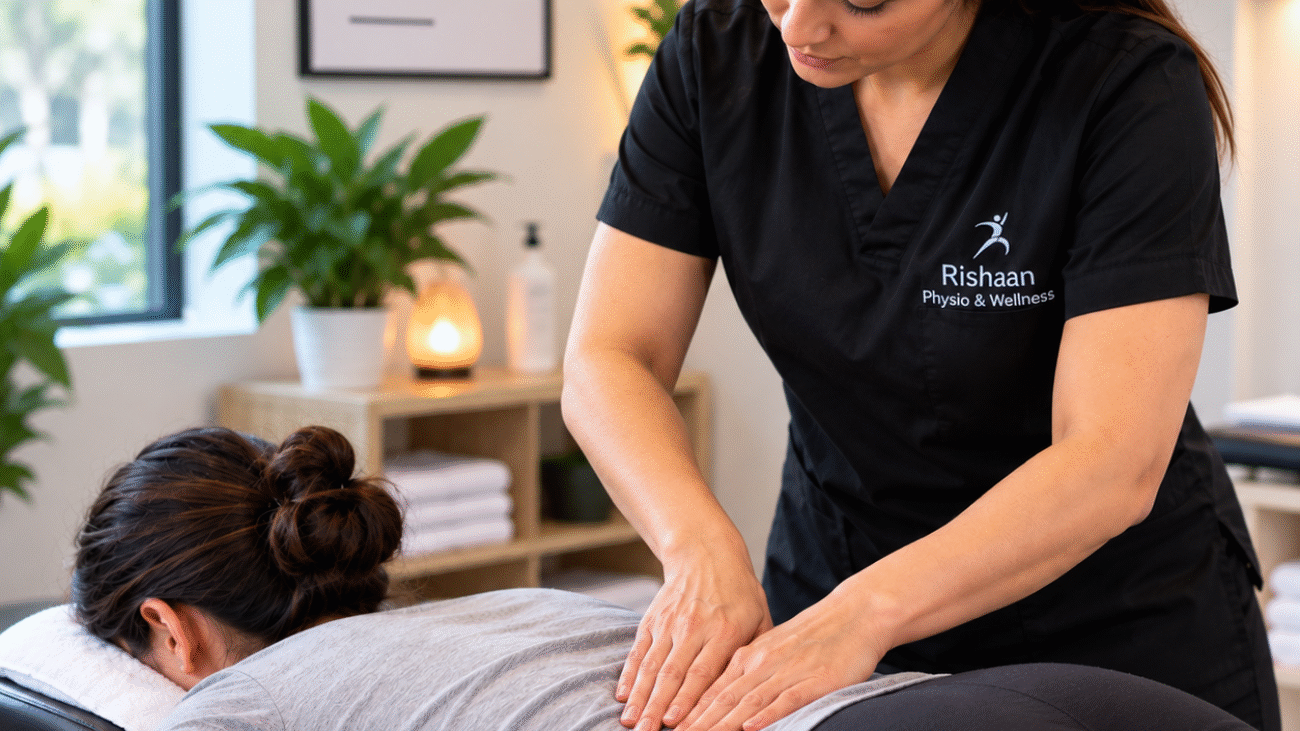
Registered massage therapy is one of the most effective hands-on treatments for the muscle tension that drives lower back pain and, in many cases, contributes directly to sciatic nerve irritation. At Rishaan Physio & Wellness Clinic in Mississauga, our RMTs treat lower back and sciatic pain every day — often alongside physiotherapy and chiropractic care for a complete solution. Here is how massage helps, what to expect, and when it is the right choice.
Why the Lower Back Hurts: The Role of Muscle Tension
Most lower back pain is not caused by a serious structural problem. It comes from muscles and connective tissue that have become tight, overworked, or guarded — often in response to prolonged sitting, poor lifting, stress, or an old injury the body never fully let go of. The key muscles involved include:
- Erector spinae — the long muscles running either side of the spine, which become chronically tight in people who sit or stand all day
- Quadratus lumborum (QL) — a deep muscle connecting the ribs to the pelvis, a very common source of one-sided lower back ache
- Gluteal muscles — weak and tight glutes shift load onto the lower back
- Piriformis — a small muscle deep in the buttock that sits directly over the sciatic nerve
- Hip flexors — shortened by sitting, they tilt the pelvis forward and compress the lumbar spine
When these muscles stay tight, they restrict movement, compress joints, and can irritate nearby nerves. That is where massage comes in.
How Massage Therapy Relieves Lower Back Pain
- Releases muscle tension and spasm — direct pressure and stretching techniques reduce the tone in overworked muscles, restoring movement and reducing pain
- Improves circulation — increased blood flow brings oxygen and nutrients to strained tissue and helps clear inflammatory by-products
- Breaks down adhesions — areas of “stuck” fascia and scar tissue that limit motion are worked through with deeper techniques
- Reduces nerve irritation — by relaxing the muscles surrounding a nerve, massage can reduce compression and the radiating symptoms it causes
- Calms the nervous system — chronic pain keeps the body in a state of tension; massage lowers stress hormones and helps the nervous system “turn down” its pain response
- Improves sleep — better sleep is one of the strongest predictors of recovery from back pain
Massage for Sciatica: What It Can and Cannot Do
Sciatica is a symptom, not a diagnosis — it means the sciatic nerve is being irritated somewhere along its path. The cause determines how much massage can help:
- Piriformis syndrome — when the piriformis muscle compresses the nerve in the buttock, massage is often one of the most effective treatments, because releasing the muscle directly relieves the pressure
- Muscular sciatica — tight glutes, hamstrings, and lower back muscles irritating the nerve respond very well to massage
- Disc-related sciatica — when a bulging or herniated disc is pressing on the nerve root, massage cannot change the disc itself, but it can significantly reduce the protective muscle spasm that amplifies the pain. Here, massage works best alongside physiotherapy for disc herniation
An assessment tells us which type you have — and if massage is not the primary treatment you need, we will say so and get you to the right practitioner in our clinic the same day.
Call (905)-800-1661
Massage Techniques We Use for Back Pain and Sciatica
- Deep tissue massage — slow, firm pressure into the deeper layers of the lower back and glutes to release chronic tension
- Trigger point therapy — sustained pressure on specific knots that refer pain into the back, hip, or leg
- Myofascial release — gentle, sustained stretching of the connective tissue to restore glide between muscle layers
- Neuromuscular techniques — targeting the piriformis and surrounding muscles to reduce nerve compression
- Assisted stretching — for the hip flexors, hamstrings, and glutes, often the key to lasting relief
Your RMT will explain each technique and adjust the pressure to your comfort. Effective treatment does not require pain — tell your therapist if anything is too intense.
What to Expect at Your Massage Session
Your first visit begins with a short health history and assessment of your posture, movement, and where the pain is coming from. Treatment typically lasts 30 to 60 minutes and focuses on the lower back, glutes, hips, and legs — the areas that feed sciatic and lower back pain. You may feel immediate relief and looseness; mild tenderness for a day afterwards is normal after deeper work. Your therapist will also give you simple stretches to maintain the benefits between sessions.
How Many Sessions Will I Need?
For a recent flare-up, one to three sessions often bring substantial relief. For chronic lower back pain or long-standing sciatica, a course of weekly sessions for four to six weeks, then tapering to maintenance, is typical. Combining massage with physiotherapy exercises usually shortens the number of visits needed.
Massage Combined with Physiotherapy and Chiropractic Care
Massage relieves the tension, but it does not, on its own, fix the reasons the tension keeps returning — weak core muscles, restricted joints, or poor movement habits. At Rishaan Physio, a complete lower back plan often includes:
- Physiotherapy — core stabilization, nerve mobilization for sciatica, and posture correction
- Chiropractic care — restoring movement to stiff lumbar and pelvic joints
- Acupuncture — for stubborn trigger points and nerve-related pain
Because all of these are under one roof, you get one coordinated plan and one team communicating about your progress.
Tips to Protect Your Back Between Sessions
- Change position every 30 minutes — set a reminder if you work at a desk
- Sit with your hips slightly higher than your knees and a small support behind the lower back
- Stretch the hip flexors and hamstrings daily
- Walk — gentle walking is one of the best things you can do for a sore back
- Lift with your legs, keep the load close, and avoid twisting under load
- Manage stress — it shows up in your back more than you think
Why Choose Rishaan Physio for Massage Therapy in Mississauga
- Registered Massage Therapists experienced in treating back pain and sciatica
- Massage integrated with physiotherapy, chiropractic, and acupuncture
- Direct billing to extended health plans, MVA, and WSIB
- Open 7 days a week with same-day and evening appointments
- Free pickup and drop-off service — helpful when sitting in a car is painful
- Unit 7, 5105 Hurontario Street, Mississauga — at Hurontario & Eglinton
Frequently Asked Questions
Is massage good for sciatica?
Yes, particularly when tight muscles such as the piriformis or glutes are irritating the nerve. For disc-related sciatica, massage helps reduce muscle spasm and pain and works best alongside physiotherapy.
Can massage make lower back pain worse?
Rarely. Mild soreness for a day after deep work is normal. A registered therapist will assess you first and adjust pressure to avoid aggravating an acute injury.
Do I need a referral for massage therapy in Ontario?
No. You can book directly. Some insurance plans request a doctor’s note for reimbursement, so check your policy or ask us.
Is massage therapy covered by insurance?
Most extended health plans cover treatment by a Registered Massage Therapist. We bill directly, so you usually pay nothing at the clinic.
Release the Tension. Relieve the Pain.
Registered Massage Therapists • Direct billing • Open 7 days • Free pickup & drop-off
Call (905)-800-1661Rishaan Physio & Wellness Clinic — Unit 7, 5105 Hurontario St, Mississauga, ON L4Z 0C9