
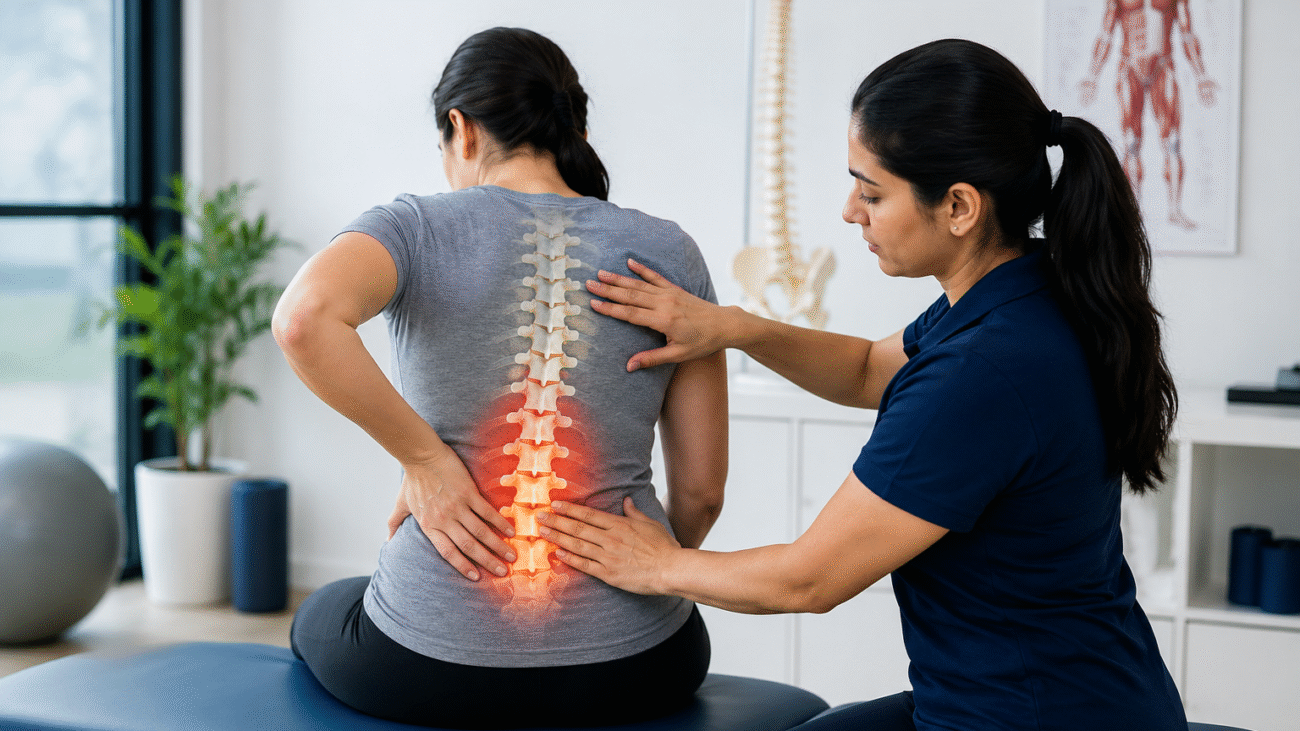
A disc herniation diagnosis can feel frightening — but it doesn’t automatically mean surgery. At Rishaan Physio & Wellness Clinic in Mississauga, our registered physiotherapists successfully treat disc herniations and bulging discs every day. For the vast majority of patients, physiotherapy is all that’s needed to relieve pain, restore function, and return to normal life.
What Is a Disc Herniation?
Your spinal discs are cushion-like structures that sit between each vertebra, absorbing shock and allowing movement. Each disc has a tough outer layer (annulus fibrosus) and a soft, jelly-like centre (nucleus pulposus).
A bulging disc occurs when the outer layer weakens and the disc protrudes outward — like a tire with a bulge. A herniated disc (also called a slipped disc or ruptured disc) is more severe: the outer layer tears and the inner material pushes through, potentially pressing directly on nearby spinal nerves.
Common symptoms include:
- Back or neck pain at the site of the disc
- Radiating pain, numbness, or tingling into the arm (cervical disc) or leg (lumbar disc)
- Weakness in the affected limb
- Pain that worsens with prolonged sitting or bending forward
- Sharp pain with sneezing or coughing
Can Physiotherapy Avoid Surgery?
In most cases, yes. Research consistently shows that 80–90% of disc herniation patients recover fully with conservative treatment — without surgery. The body has a remarkable ability to reabsorb disc material over time, and physiotherapy accelerates this process while managing pain and preventing the condition from worsening.
Surgery is typically only considered when there is progressive neurological deficit (worsening weakness or loss of sensation), bowel or bladder involvement, or when conservative treatment has been tried for 6–12 weeks without improvement.
How Physiotherapy Treats Disc Herniation
Directional Preference Exercise (McKenzie Method)
Many disc herniation patients have a “directional preference” — specific movements that centralize their pain (move it from the leg back to the back) and reduce symptoms. Extension-based exercises are common for lumbar herniations. Identifying and consistently performing these movements is often the most powerful tool in disc rehabilitation.
Manual Therapy
Gentle spinal mobilization and traction techniques to decompress the affected disc level, reduce nerve irritation, and restore movement to the spine.
Core Stabilization
The deep core muscles — the transverse abdominis, multifidus, and pelvic floor — act as a natural corset for the spine. Strengthening these muscles reduces load on the discs and prevents re-injury.
Postural and Ergonomic Education
Many disc herniations are aggravated by prolonged sitting in poor postures. Your physiotherapist will assess your workstation setup and show you the optimal postures and movement strategies to protect your discs throughout the day.
Neural Mobilization
When a herniation irritates a nerve, neural mobilization techniques (nerve flossing) help reduce the nerve’s sensitivity and restore its normal mobility through surrounding tissue.
What to Avoid With a Disc Herniation
- Prolonged sitting without breaks
- Heavy lifting with a flexed (rounded) spine
- Repeated forward bending, especially in the morning
- High-impact activities that compress the spine (running on hard surfaces)
Frequently Asked Questions
Can physiotherapy fix a herniated disc?
Yes — 80–90% of disc herniation patients recover fully with physiotherapy and conservative treatment, without surgery. Physiotherapy reduces nerve irritation, strengthens the supporting muscles, and corrects the movement patterns that contributed to the injury.
How long does disc herniation take to heal?
Most patients see significant improvement within 6–12 weeks of physiotherapy. The disc material is often reabsorbed by the body over 6–12 months. Recovery is faster with early, consistent treatment.
What exercises should I avoid with a herniated disc?
Avoid repeated forward bending, sit-ups, deadlifts with a rounded back, and any exercise that increases your leg pain. Your physiotherapist will identify your specific directional preference and prescribe safe exercises accordingly.
Does a bulging disc go away on its own?
Many disc herniations do resolve with time and appropriate physiotherapy. The body can reabsorb disc material, especially larger herniations. Physiotherapy speeds this process and prevents recurrence.
Is disc herniation covered by insurance in Ontario?
Yes — physiotherapy for disc herniation is covered by most extended health plans. WSIB and MVA coverage is also available if the injury occurred at work or in a motor vehicle accident. Rishaan Physio offers direct billing.
Book Disc Herniation Treatment at Rishaan Physio
Most patients recover without surgery. Let us help you be one of them.
No referral needed | Same-day appointments | Direct billing
📍 5105 Hurontario St, Unit 7, Mississauga 📞 Call (905)-800-1661