
Despite its name, you don’t have to play tennis to develop tennis elbow. At Rishaan Physio & Wellness Clinic in Mississauga, we treat tennis elbow in office workers, tradespeople, musicians, and athletes alike — anyone who performs repetitive gripping or wrist movements.
The frustrating thing about tennis elbow is that it’s slow to heal. Many people try rest, ice, and over-the-counter pain relievers — only to find the pain returns the moment they go back to normal activity. The key is understanding why it becomes chronic and treating it properly.
What Is Tennis Elbow?
Tennis elbow — medically known as lateral epicondylitis — is a condition where the tendons that attach the forearm muscles to the bony bump on the outside of the elbow (the lateral epicondyle) become damaged and degenerated.
It’s caused by repetitive overuse — small tears accumulate in the tendon faster than the body can repair them. Over time, the tendon degenerates rather than healing, becoming a chronic problem.
Symptoms include:
- Pain and burning on the outer side of the elbow
- Weak grip strength
- Pain when shaking hands, turning a doorknob, or lifting objects
- Pain that radiates into the forearm
- Tenderness when pressing on the lateral epicondyle
Tennis Elbow vs. Golfer’s Elbow — What’s the Difference?
Tennis elbow affects the outside of the elbow (extensor tendons). Golfer’s elbow (medial epicondylitis) affects the inside of the elbow (flexor tendons). Both are treated with physiotherapy, but with different exercise approaches. Your physiotherapist will assess which condition you have and tailor treatment accordingly.
Why Tennis Elbow Becomes Chronic
Early on, tennis elbow is an inflammatory problem. Left untreated, the tissue transitions into a degenerative state called tendinopathy — where the body has stopped actively trying to repair the tendon. At this stage, rest alone does almost nothing. The tendon needs specific loading stimulus to regenerate.
Physiotherapy Treatment for Tennis Elbow
Manual Therapy
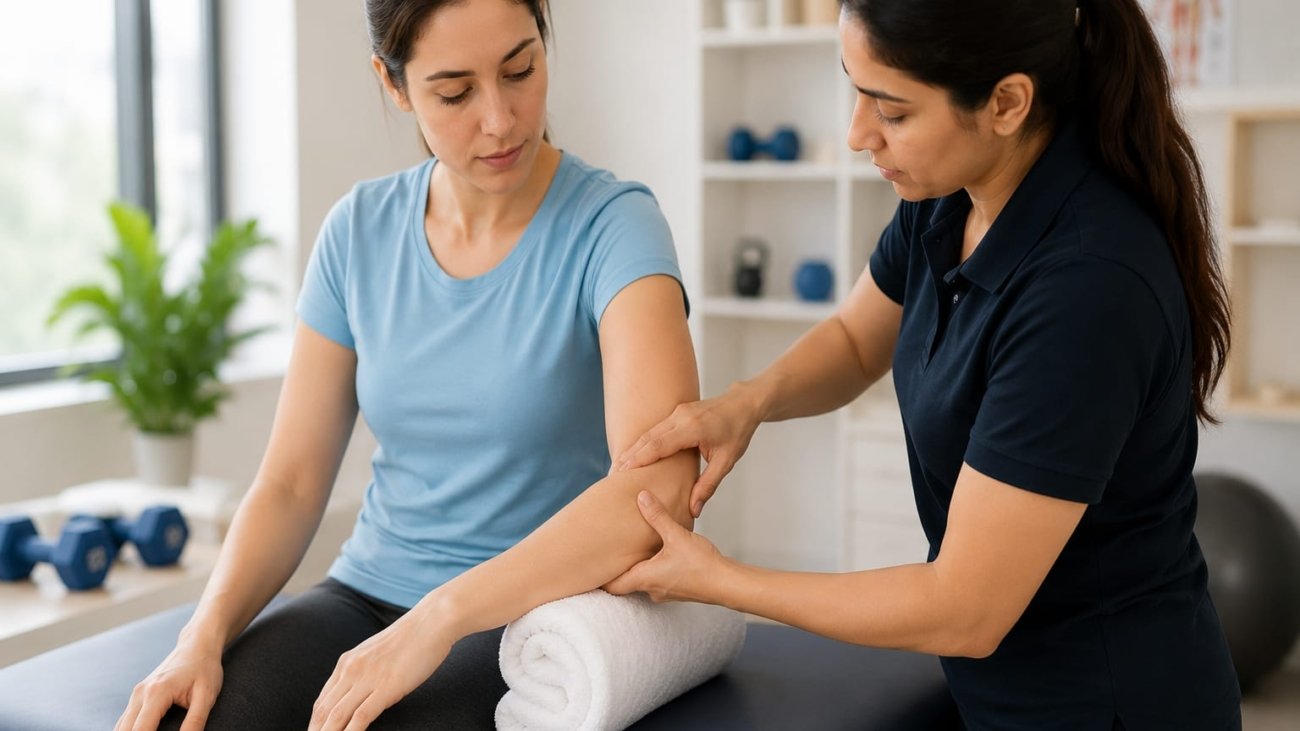
Soft tissue release of the forearm extensors and deep transverse friction massage at the tendon attachment site. This breaks down adhesions, improves local circulation, and prepares the tissue for exercise.
Eccentric and Isometric Exercises
The most evidence-based approach for tendinopathy. Eccentric wrist extension exercises place a controlled load through the degenerating tendon, stimulating collagen production and tissue regeneration. Isometric exercises are used first when pain is more acute.
Shockwave Therapy
For chronic tennis elbow (3+ months), shockwave therapy is highly effective. The acoustic waves stimulate healing in the degenerated tendon tissue and provide lasting pain relief — usually within 3–5 sessions.
IFC (Interferential Current)
Electrical therapy to reduce pain and inflammation at the elbow, improving comfort during the rehabilitation process.
Bracing and Load Management
A counterforce brace worn just below the elbow can reduce stress on the lateral epicondyle during daily activities. Your physiotherapist will advise on when and how to use it.
Recovery Timeline
- Mild / early tennis elbow: 4–6 weeks
- Chronic tennis elbow: 3–6 months with consistent rehabilitation
Consistency with your home exercise program is the single biggest factor in how quickly you recover.
Frequently Asked Questions
Does tennis elbow go away on its own?
Mild cases may resolve with rest over several months, but chronic tennis elbow rarely heals without targeted treatment. Without addressing the tendon degeneration through specific loading exercises, the pain often returns.
How does physiotherapy treat tennis elbow?
Physiotherapy uses manual therapy, eccentric strengthening exercises, and shockwave therapy to break the cycle of degeneration and stimulate tendon healing. This addresses the root cause, not just the pain.
How long does tennis elbow take to heal?
Mild cases can resolve in 4–6 weeks with physiotherapy. Chronic cases (3+ months) typically take 3–6 months of consistent rehabilitation. Starting treatment early significantly shortens this timeline.
Is shockwave therapy effective for tennis elbow?
Yes — shockwave therapy is one of the most effective treatments for chronic tennis elbow. Studies show significant pain reduction and improved function in 70–80% of patients who haven’t responded to other treatments.
Can I still use my arm with tennis elbow?
Yes, but with modification. Completely resting the arm is not recommended — the tendon needs controlled loading to heal. Your physiotherapist will guide you on what activities to continue, modify, or temporarily avoid.
Book Tennis Elbow Treatment at Rishaan Physio
Manual therapy + shockwave therapy — at one clinic in Mississauga.
No referral needed | Same-day appointments | Direct billing
📍 5105 Hurontario St, Unit 7, Mississauga 📞 Call (905)-800-1661