
Call (905)-800-1661
Fall is peak running season in Mississauga. The humidity lifts, the Waterfront Trail and Credit River paths fill up, and race calendars — from local 5Ks to the big Toronto marathons in October — push runners to increase their mileage. It is also the season when our clinic sees a spike in shin splints, runner’s knee, and Achilles and arch pain.
Many of these injuries share a common root: the way the foot hits the ground and rolls through each stride. When foot mechanics are off, the strain is transferred up the leg thousands of times per run. Custom orthotics are one of the most effective tools for correcting that — but only when they are prescribed for the right runner and the right problem. Here is how to know if they are for you.
Overpronation: The Mechanics Behind Many Running Injuries
Pronation is normal — the foot is designed to roll slightly inward after landing to absorb shock. Overpronation is when that inward roll goes too far or lasts too long, collapsing the arch and rotating the shin and knee inward with every step.
Signs you may overpronate:
- Your running shoes wear down heavily on the inside edge
- Your arches flatten noticeably when you stand
- Your knees drift toward each other when you squat or land
- Your ankles look like they roll inward when viewed from behind
- You have a history of injuries on the inside of the shin, knee, or arch
Overpronation is not a disease and does not always need correcting — plenty of runners overpronate without injury. It becomes a problem when it combines with increased mileage, weak hips, or poor footwear to overload specific tissues.
Running Injuries Linked to Foot Mechanics
Shin splints (medial tibial stress syndrome)
Pain along the inner edge of the shin bone. Excessive pronation pulls on the muscles and connective tissue attached to the tibia with each stride. Shin splints are one of the most common complaints among runners who have recently increased distance or intensity.
Runner’s knee (patellofemoral pain)
Aching around or behind the kneecap, worse on stairs, hills, and after sitting. When the foot rolls in, the shin rotates and the kneecap tracks poorly in its groove. Foot support is often one piece of the solution alongside hip strengthening.
IT band syndrome
Sharp pain on the outside of the knee. Altered foot and hip mechanics increase friction where the IT band crosses the knee. Read our full guide on IT band syndrome treatment.
Plantar fasciitis and Achilles tendinopathy
Heel and arch pain, or pain at the back of the heel, especially with the first steps in the morning. A collapsing arch stretches the plantar fascia and changes the load on the Achilles.
Posterior tibial tendon problems
Pain on the inside of the ankle. This tendon supports the arch and is overworked by chronic overpronation.
Call (905)-800-1661
How Custom Orthotics Help Runners
Custom orthotics are made from a cast or 3D scan of your feet, built to correct the specific mechanical fault identified in your assessment. For runners, a properly prescribed orthotic:
- Controls overpronation — supports the arch and slows the inward roll, reducing rotational strain on the shin and knee
- Redistributes load — cushions and offloads high-pressure areas such as the heel and forefoot
- Improves alignment from the ground up, so the knee and hip track more efficiently
- Reduces tissue strain on the plantar fascia, posterior tibial tendon, and shin muscles
- Allows continued training while injured tissue recovers, rather than forcing complete rest
Running orthotics differ from everyday orthotics: they are typically slimmer, lighter, and built to fit inside running shoes with the right flexibility for a running stride. Tell us which shoes you run in and bring them to your fitting.
Are Custom Orthotics Better Than Stability Shoes or Store-Bought Insoles?
Stability shoes and over-the-counter insoles provide generic support and work for mild cases. Custom orthotics are built for your specific foot, arch height, and injury, and are the better option when:
- You have a recurring injury that stability shoes have not resolved
- Your feet are significantly flat, high-arched, or asymmetrical
- You run higher mileage or are training for a race
- You have a diagnosed condition such as posterior tibial tendon dysfunction
For a detailed comparison, see custom orthotics vs. store-bought insoles.
Orthotics Are One Piece — Not the Whole Puzzle
An honest point that many runners do not hear: orthotics manage the foot, but the majority of running injuries also involve training errors (too much, too soon) and weakness higher up — particularly in the glutes and hips, which control knee alignment. That is why at Rishaan Physio, orthotics for runners are prescribed within a complete plan:
- Physiotherapy — hip and calf strengthening, running form cues, and a graded return-to-running plan
- Sports massage — releasing tight calves, shins, and IT bands
- Shockwave therapy — for stubborn plantar fasciitis or Achilles tendinopathy
- Footwear review — orthotics only work in shoes that suit your foot and are not worn out
- Training advice — most runners should increase weekly mileage by no more than about 10%
What to Expect at a Runner’s Orthotics Assessment
- History — your injury, mileage, race goals, surfaces, and shoe history
- Foot and lower limb exam — arch type, ankle and hip mobility, calf and glute strength
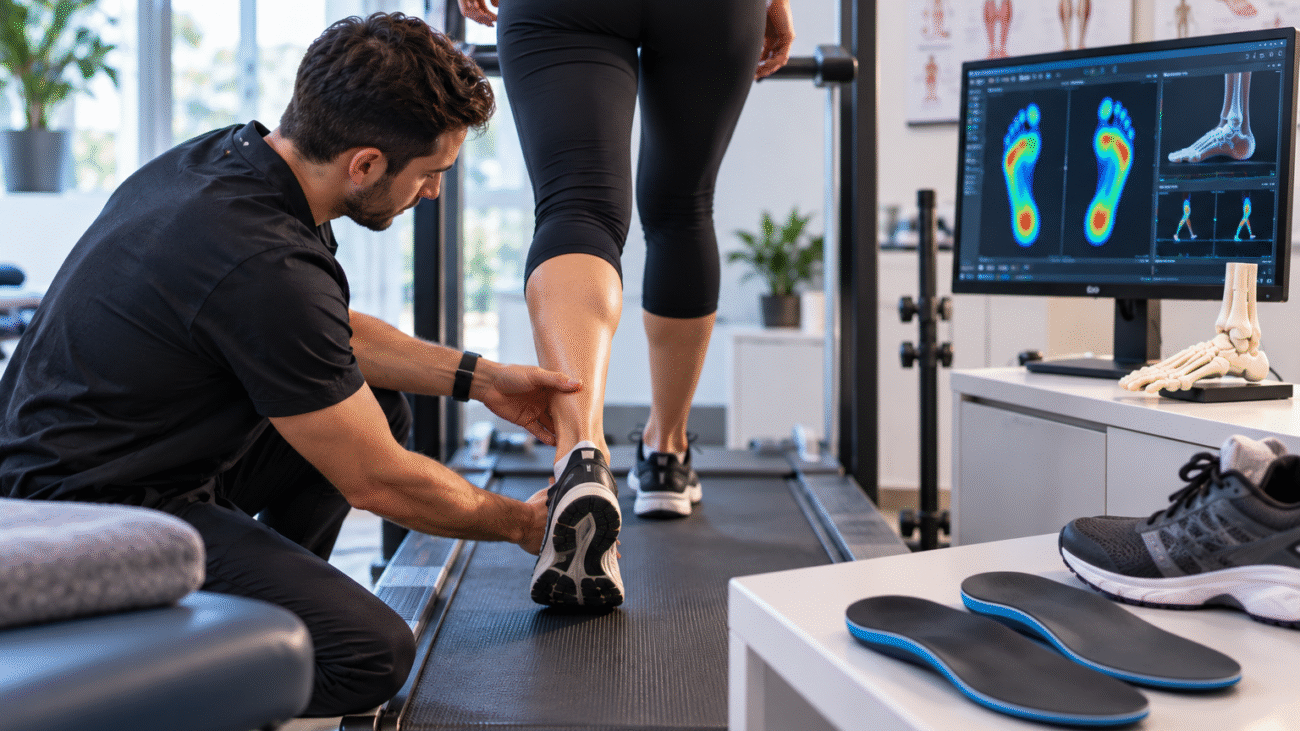
- Gait analysis — observing how you walk and run to identify overpronation, knee collapse, or asymmetry
- Casting or scanning in a corrected foot position
- Fitting and break-in plan — typically one to two weeks of gradual wear before running in them
- Follow-up to confirm the orthotics are performing and fine-tune if needed
Are Running Orthotics Covered by Insurance?
Most extended health plans in Ontario include custom orthotics, often with a set amount every one to two years. A prescription and assessment are required, which we provide. We handle the paperwork and bill directly wherever your plan allows.
Why Choose Rishaan Physio for Runners in Mississauga
- Full running gait assessment — not just a foot scan
- Honest recommendations: if you need hip strengthening instead of orthotics, we will say so
- Orthotics, physiotherapy, massage, and shockwave therapy under one roof
- Direct billing to most insurance plans
- Open 7 days a week — early and evening appointments around your training schedule
- Free pickup and drop-off service
- Unit 7, 5105 Hurontario Street, Mississauga — Hurontario & Eglinton
Frequently Asked Questions
Can I run with orthotics right away?
Not immediately. Break them in with walking for one to two weeks, then introduce short runs. Rushing the transition can cause new soreness.
Do orthotics cure shin splints?
They address one major cause — overpronation — and often bring significant relief. Shin splints also require managing training load and strengthening the calves and hips for lasting results.
Will orthotics change my running form?
They improve foot alignment and can subtly improve how your knee tracks. They do not replace form coaching or strength training, but they make good mechanics easier to achieve.
How long do running orthotics last?
Typically two to four years, depending on mileage and body weight. High-mileage runners may need replacement sooner. If your symptoms return, have them checked.
Run Pain-Free This Season
Gait analysis • Custom orthotics • Direct billing • Open 7 days • Free pickup & drop-off
Call (905)-800-1661Rishaan Physio & Wellness Clinic — Unit 7, 5105 Hurontario St, Mississauga, ON L4Z 0C9