

Call (905)-800-1661
When back pain lingers for weeks, or sciatica sends sharp, electric pain down your leg every time you sit, the usual advice — rest, heat, anti-inflammatories — starts to feel inadequate. Many Mississauga patients come to Rishaan Physio & Wellness Clinic looking for something that reduces the pain without more medication, and acupuncture is one of the most effective options we offer.
Acupuncture has a long track record for back pain and is now supported by a substantial body of modern research. This guide explains how it works for sciatica and lower back pain, what a session is like, what results to expect, and how we combine it with physiotherapy, massage, and chiropractic care for lasting relief.
Understanding Back Pain and Sciatica
Lower back pain most often comes from the muscles, joints, and discs of the lumbar spine — strained by lifting, sitting, poor posture, or repetitive load. It is usually felt across the lower back and may spread into the buttocks.
Sciatica is different: it is pain caused by irritation of the sciatic nerve, which runs from the lower spine through the buttock and down the leg. The hallmark is pain, tingling, or numbness that travels below the knee. Common causes include a bulging disc pressing on a nerve root, a tight piriformis muscle compressing the nerve in the buttock, or narrowing of the spinal canal.
Both conditions share a feature that makes acupuncture particularly useful: protective muscle spasm and a nervous system that has become sensitized to pain.
How Acupuncture Relieves Back Pain and Sciatica
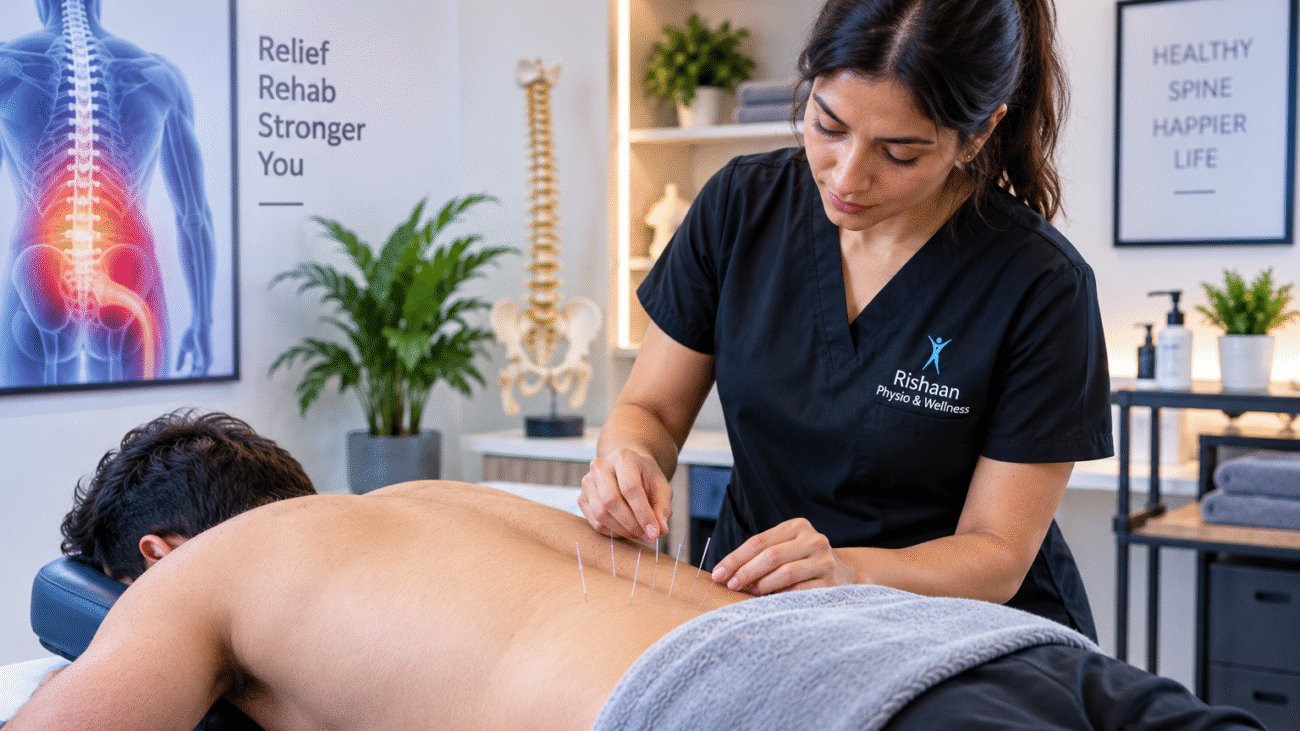
Acupuncture involves inserting very fine, sterile, single-use needles at specific points on the body. Modern research explains its effects through several mechanisms:
- Triggers the body’s natural painkillers — needling stimulates the release of endorphins and other pain-modulating chemicals in the brain and spinal cord
- Releases tight muscles — needles placed into trigger points in the lower back, glutes, and piriformis cause the muscle to relax, reducing pressure on nerves and joints
- Reduces inflammation around irritated nerve roots and joints
- Improves local blood flow, supporting tissue healing
- Calms a sensitized nervous system — in chronic pain, the nervous system amplifies signals; acupuncture helps reset this, which is why patients often report feeling less “on edge” as well as less pain
What Does the Research Say?
Acupuncture for chronic lower back pain is one of the most studied applications in the field. Large reviews have found it more effective than no treatment and than sham (placebo) treatment for reducing pain and improving function, and it is included as a recommended option in several clinical guidelines for chronic back pain. For sciatica, evidence is smaller but positive, with trials showing reduced pain intensity and improved leg symptoms, particularly when the nerve irritation involves tight muscles.
It is not a cure for a disc herniation and results vary between individuals — but for a low-risk treatment, its ability to reduce pain and medication use is well established.
Call (905)-800-1661
What to Expect at Your Acupuncture Session
Assessment
Your practitioner reviews how your pain started, where it travels, what aggravates it, and your general health. We examine your back, hips, and leg to identify the structures involved — particularly whether tight muscles or a disc are the primary driver of your sciatica.
Treatment
Needles are typically placed along the lower back, buttocks, hips, and down the leg following the path of the nerve, plus distal points on the hands or feet. You may feel a brief tap or a dull, heavy sensation — many patients find this oddly satisfying, especially when a tight muscle releases. The needles stay in for 20–30 minutes while you rest. Electroacupuncture, where a gentle current is passed between needles, may be used for nerve pain.
Course of treatment
Acute flare-ups may settle in two to four sessions. Chronic back pain or established sciatica usually needs a course of six to ten sessions over several weeks, with benefits building over time. Your practitioner reassesses as you go.
Acupuncture vs. Dry Needling
Both use the same fine needles, but the approach differs. Dry needling (also called IMS) targets specific muscular trigger points and is used mainly by physiotherapists to release tight muscle. Acupuncture uses a broader system of points and addresses pain and nervous system sensitivity as well as muscle tension. Many sciatica patients benefit from both — we explain the differences in detail in our guide to acupuncture vs. dry needling.
Combining Acupuncture with Physiotherapy, Massage and Chiropractic Care
Acupuncture relieves pain and tension, which creates the window for other treatments to fix the underlying cause. At Rishaan Physio, a complete plan for back pain or sciatica often includes:
- Physiotherapy for sciatica — nerve mobilization, core strengthening, and posture correction to keep the pain from returning
- Massage therapy — deep tissue release of the glutes, piriformis, and lower back muscles
- Chiropractic care — restoring movement to restricted lumbar and pelvic joints
Because all of these are under one roof, we can schedule them in the same visit or the same week and adjust the plan as you improve.
Is Acupuncture Safe for Back Pain?
When performed by a trained, regulated practitioner using sterile single-use needles, acupuncture is very safe. Side effects are minor and uncommon — a small bruise or brief tiredness after treatment. It is suitable for people who cannot take anti-inflammatories, are pregnant, or want to reduce medication. Concerns and common myths are addressed in our article on acupuncture safety, myths and benefits.
Simple Habits That Support Your Recovery
- Avoid sitting for more than 30 minutes at a stretch — stand, walk, reset
- Use a small lumbar support when driving or working
- Walk daily — gentle movement is better for back pain than rest
- Sleep on your side with a pillow between your knees if sciatica flares at night
- Keep up the stretches and exercises your physiotherapist gives you between sessions
Why Choose Rishaan Physio for Acupuncture in Mississauga
- Trained, regulated practitioners using sterile single-use needles
- Acupuncture integrated with physiotherapy, massage, and chiropractic in one plan
- Direct billing to extended health plans, MVA, and WSIB
- Open 7 days a week, same-day and evening appointments
- Free pickup and drop-off — valuable when sitting in a car is painful
- Unit 7, 5105 Hurontario Street, Mississauga — Hurontario & Eglinton
Frequently Asked Questions
How many acupuncture sessions do I need for sciatica?
Most patients need 6–10 sessions over several weeks, with improvement building gradually. Acute flare-ups may respond faster. Your practitioner will reassess after the first few visits.
Can acupuncture cure a herniated disc?
No treatment “cures” a disc, but most herniations improve naturally over months. Acupuncture reduces pain and muscle spasm in the meantime and, combined with physiotherapy, helps you stay active while the disc settles.
Does acupuncture for back pain hurt?
The needles are extremely thin. You may feel a light tap or a dull ache at some points, and a release sensation when a tight muscle relaxes. Most people find the session relaxing.
Is acupuncture covered by insurance in Ontario?
Many extended health plans cover acupuncture, either as its own benefit or under physiotherapy. We check your coverage and bill directly wherever possible.
Relieve the Pain, Calm the Nerve — Book Your Acupuncture Session
Same-day appointments • Direct billing • Open 7 days • Free pickup & drop-off
Call (905)-800-1661Rishaan Physio & Wellness Clinic — Unit 7, 5105 Hurontario St, Mississauga, ON L4Z 0C9